It’s hard to imagine now, but before L-Acoustics’ Soundvision became a product in 2004 it started as an Excel file on the computer of company founder and particle physicist Dr. Christian Heil. Since then, the software has helped shape countless installations, and transformed spaces and experiences, including for stadiums and arenas.
“Sports fans expect a much more full-range audio experience now,” says Ross Brett, Global Lead Application Engineer – Sports Facilities at L-Acoustics. Stadium owners also want to be able to keep the stadium in use all year with concerts and events; that requires a flexible audio and acoustical profile to support different audio experiences.
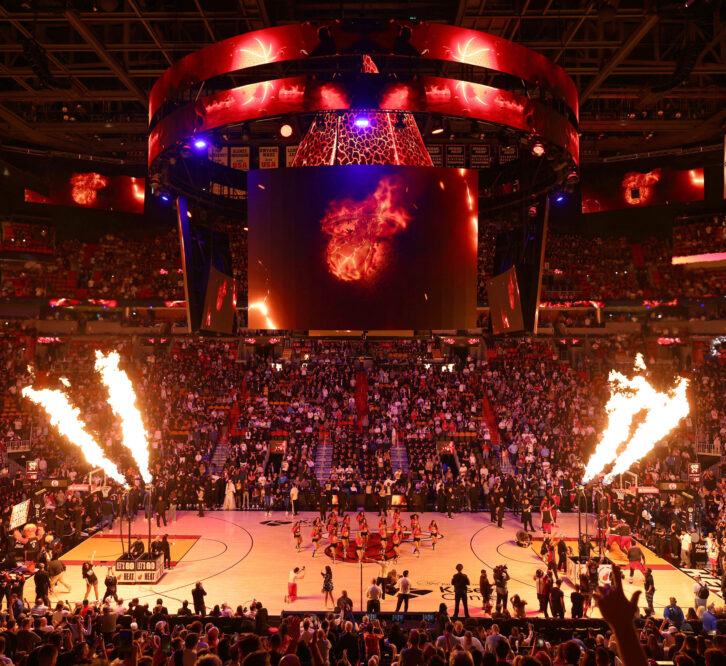
Case in point, the Miami HEAT’s Kaseya Center in Downtown Miami’s Entertainment District also hosts over 80 non-basketball events annually, from A-list concerts to national conferences. For the 2025 season, the Kaseya Center got a new L-Acoustics K2 sound system installed by Solotech Systems, and Soundvision played an irreplaceable role in fulfilling the wishlist in a timely and accurate way.
“Coverage was a huge problem for their existing design,” Brett recalled, pointing out complexities, including the range of desired use cases, existing fixed set points and production grid, temporary premium seating, and some acoustically unfriendly banners that needed to be overcome. While Kaseya Center is an expansive space, it has an extremely tight payload footprint. Soundvision mapped how to optimize every seat in the stadium and guided the path to overcoming all the variables.
The new sound system comprises eight arrays of 10 K2 each, flown around the central display over the court, with four of the arrays (NE, NW, SE, SW) each backed by a hang of four KS28 subs time-aligned with the main PA system. A total of 20 16-channel LA7.16i amplified controllers housed in equipment racks drive all the K2, while four LA12X power the subs. Ground stacks of four more KS28 subs per side are positioned at each end of the court for additional LFE punch. Thirty-two delay arrays comprised of various combinations of a total of 75 A15i Focus and Wide enclosures provide coverage to the upper bowl seats. These are also efficiently powered by eight more LA7.16i.
Part of choosing the L-Acoustics speakers was the power-for-size they deliver, but an optimal speaker is only the starting point in shaping today’s stadium experiences. Mapping software can optimize speakers, but it is also a design aid for modeling problem-solving. In Brett’s Kaseya example, the stadium banners were made of an “acoustically impossible” material that blocked the higher frequencies and caused gaps from the shadowing. The fix dictated an acoustic curtain of the A15i enclosures that would extend into the upper tier for capacity crowds. The flexible LA7.16i amps support discreet power for each speaker, so when the upper tier speakers are not needed, they are turned off; when they are needed, the amps deliver maximum resolution for the vast space.
 “Without this type of acoustical modeling, there’s no way you could do a design to this level of complexity and accuracy,” Brett says. “You can put the scoreboard into position, put the grid in to confirm the arrays will fit, and model shadowing to predict and overcome those areas that needed a bit more.” Designers can also accurately capture and harness the maximum direct reverb while minimizing unwanted reflections.
Soundvision can also help identify trouble spots early in the process. For Kaseya, he says, the challenges from the previous design were easily identified—some of them created by unforeseen changes to the physical space. With Soundvision’s help, and with input from Soundvision-savvy integrator Solotech, the results were more accurate and the process much faster.
It all plays into keeping up with fan expectations for stadium audio. “Five to six years ago, line arrays were the aspirational trend,” Brett recalls, “now they’re the norm. Intelligibility has been coming along for a long time, but now it’s a much more full range experience, with subwoofers, the bass experience, low frequency effects that add impact for moments like player walks-ons.” (The subs at Kaseya do just that.) He says “it’s now almost a false economy not to build in a great, flexible audio experience, because of the return on investment from fan satisfaction and from tour bookings and other events, when touring companies know they can rely on the what the system can do. “It’s a constantly evolving piece of software,” Brett says of Soundvision. “There’s a team of people at L-Acoustics dedicated to developing it, bringing on new features, so that it’s ready and in a place to deliver on new products. We put a lot of resources towards it and you can do more with it all the time.”
The most recent addition is Soundvision Connect, a cloud collaboration version that expands who can be included in the process. It’s a collaborator-focused version that allows the designer to share files with venue managers, architects or other non-audio professionals and lets them visualize and walkthrough the venue audio design.
There’s also a first of its kind partnership with Vectorworks, allowing the import of Vectorworks files and vice versa, which can help with managing sightlines, décor interaction, and other cross-discipline variables.
Soundvision can also export design reports, and rigging point maps, and it can be exported into LA Network Manager as an integral part of the calibration file onsite. So increasingly this type of software can be instrumental to the entire integration process.
Integrators who are interested in learning more about modeling and acoustics in general, and Soundvision in particular, can take advantage of L-Acoustics training and certification