A new study from the University of Cambridge and Meta Reality Labs has surmised that the human eye can see in greater detail that was previously believed. The study, which was published in the scientific journal Nature, argues that, in the right conditions, humans can see up to 94 pixels per degree (ppd) for grayscale images. This is much higher than the 60 ppd maximum that was previously believed.
“As large engineering efforts go towards improving the resolution of mobile, augmented reality (AR), and virtual reality (VR) displays, it is important to know the maximum resolution at which further improvements bring no noticeable benefit,” writes study authors Maliha Ashraf, Alexandre Chapiro and Rafał K. Mantiuk. “This limit is often referred to as the retinal resolution, although the limiting factor may not necessarily be attributed to the retina. To determine the ultimate resolution at which an image appears sharp to our eyes with no perceivable blur, we created an experimental setup with a sliding display, which allows for continuous control of the resolution. The lack of such control was the main limitation of the previous studies.”
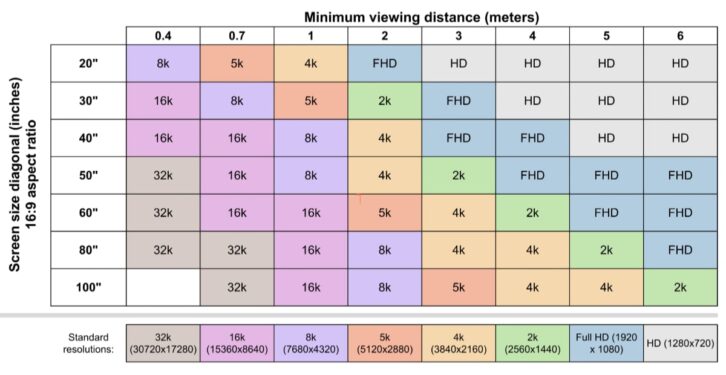
The authors have published the chart above to summarize their findings, which details the resolution viewable by the human eye when taking into account aspect ratio, screen size, and distance from the image. The authors suggest that future technology to push display resolutions to 16K or even 32K, given the right conditions, would not be wasted.