The promise of the IP Media eXperience (IPMX) is to create an open ecosystem of plug-and-play products and services in the Pro-AV market, with the idea of bringing in advanced features from the broadcast market in an affordable and easy-to-use manner. IPMX does this by adapting and simplifying the SMPTE ST 2110 broadcast technology, as follows:
- IPMX removes the need for PTP synchronization, greatly simplifying the network setup and making it possible to use significantly less expensive networking equipment.
- The NMOS control plane (which is required in IPMX) has been enhanced to automate some of the manual configuration steps, including propagating display capabilities back to the stream sources.
- Support for low-complexity video compression (JPEG-XS), which allows low latency operation over lower speed copper networks (1 Gb/s). This also includes optimizations to provide good quality for content coming from computer screens, with content such as spreadsheets and text.
This sounds great on paper, but how is it working in practice? The ST 2110 set of standards is complex, and large deployments typically require high levels of expertise to deal with the interoperability problems that will certainly arise. Also, having an open specification where multiple vendors can play is nice, but how many are actually playing in this ecosystem? How well is it working, for a potential customer, how do they know if devices will really interoperate? Will it be like the old “plug-and-pray” days?
Fortunately, there is a good answer to this problem. In January 2026, there was an IPMX certification event at the EBU in Geneva. The EBU was chosen as a neutral third-party to run the certification, and AIMS published the “IPMX Product Qualification and Certification Requirements” document prior to the event.
So, how many companies and products showed up in Geneva? How many products got certified? Is this a viable ecosystem? The answer is yes – there were 8 companies present at the event, and 38 products in multiple categories were certified. The full list can be found in the AIMS Alliance Solutions website. In this site, you can search products by vendor and solution.
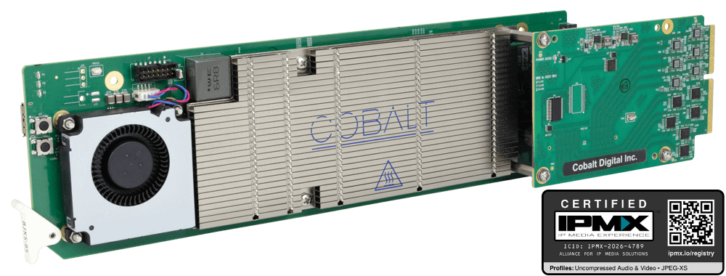
The certified products all received a badge, like this one:

The badge has a certification number, and a QR code that leads to that product’s certification page. Vendors will attach this badge to certified products.
Is the work done? No, no yet. There is still development in additional features, and other certification events are planned. At this point, it is clear that IPMX has the momentum and adoption in the vendor community to move forward, and to create a real seamless experience for the users – without sacrificing quality.