One of the most interesting developments in audio over the past 20 years is the rise of spatial sound technology that can change a room, whether to manage troublesome acoustics or create immersive experiences. Since Meyer Sound Constellation debuted in 2006 (and dominated the trend for the first decade), other acoustical and spatial systems have emerged from our industry’s best minds to bring unique experiences to theaters, restaurants, attractions, and live events. Not to be left out, a number of houses of worship have proven that spatial sound has a place in church too.
Earlier this year, New Life Church in Corpus Christi (left) unveiled its unusual new location featuring a d&b audiotechnik Soundscape audio system with En-Scene and En-Space modules. Soundscape draws on 40 years of processing innovation to provide a sophisticated spatial platform. Five years in development, under the supervision of Ralf Zuleeg, Head of Sales Services and Application Engineering at d&b, it had its first showing at AES 2017 in New York and made its official debut in 2018 at ISE. The following year saw its theatrical debut on London’s West End and since then it has served in events, tours, and venues across the world, including houses of worship.
New Life Church is housed in a structured tent with the unique acoustics you might expect. The system installed by E2i Design resulted in a dramatic transformation of the tent’s acoustics, improving the depth and localization of the worship band in the mix, and increasing engagement from the congregation through the innovative voice lift technique.
Because the church is adjacent to a military airstrip, it required the construction of a non-acoustically optimal tent structure with its inherent lack of reflective surfaces. E2i Design found d&b audiotechnik Soundscape with the En-Space an ideal solution. “Tent fabrics don’t offer the same reflectivity as permanent construction,” said Evan Hamilton, Chief Technical Officer at E2i Design. “Soundscape with EnSpace enabled us to create natural-sounding reverb times with resonances better than many traditional church environments.”
The core of the d&b Soundscape is the DS100 Signal Engine audio processor with Dante networking and a 64×64 level and delay matrix with in- and output processing. Users can do object-based or channel-based audio. The object-based software module En-Scene provides detailed control that allows users to play with audio reality either to support detailed localization to what listeners see on stage or to create spatial audio illusions that bend expectation. The En-Space software module can manipulate room acoustics and even match them to recreate renowned acoustics spaces.
For New Life, the decision to include the Soundscape En-Scene module proved to be instrumental to the venue’s transformation. “New Life Church has a large worship band with six singers,” commented Hamilton. “En-Scene allows us to place those musicians in the mix, corresponding to where they are on stage, and provide a great sense of localization to everyone across the congregation. En-Scene is incredible, you gain depth and spaciousness in your mix where you never previously had it.”
During the process of deploying Soundscape, E2i Design realized how much the lackluster tent acoustics affected the sound experience of those on stage and also negatively impacted the experience of the congregants. “I am particularly proud that we leveraged Soundscape to provide an even more immersive environment through a voicelift system,” said Hamilton. “With mics hung over the congregation and piping them through En-Space, everyone in the audience experiences a greater sense of presence, especially while singing along… they feel like they’re in the same acoustic space as the band, making them feel more connected.”
E2i Design was able to provide a cost-effective solution to New Life Church by repurposing the existing d&b audiotechnik xS-Series system from the church’s old location. “When constructing New Life Church’s new location, their dream was to create an immersive worship experience, even though it was in a tent,” says Hamilton. “We were immediately off to a great start with their previously purchased xS-Series system. We integrated it with the DS100 and some additional d&b loudspeakers, and now New Life Church has a full-scale Soundscape PA.”
“The planning and approvals required due to the church’s proximity to the military airstrip made this a long process,” continued Hamilton. “ Now that the church is finally open, they have so much pride and passion for their new home because of its uniqueness and how amazing it sounds.” Hamilton adds that he sees a benefit specific to churches, beyond the immersive aspect. “Soundscape with En-Scene empowers a volunteer who knows absolutely nothing about audio, let alone immersive audio, to easily create a phenomenal mix with space and depth. Plus, because elements don’t compete against each other, your overall volume is down across the board. We’ve had so much success with clients by showing them this one thing alone, I find it one of Soundscape’s most compelling features.”
The complete system installed by E2i Design for New Life Church included: five xS-Series 245-D loudspeakers for the mains; two 10S-D point source as extensions; six 21S subwoofers; eight 85 loudspeakers as surrounds; and six 44S loudspeakers for front fills. The system is powered by a combination of 30D and 5D amplifiers. A DS10 Audio Network Bridge Networking handles signal routing, and processing is provided via the DS100 Signal Engine running Soundscape with En-Scene and En-Space software. Half of the 8S speakers and two 24S-D were sourced from New Life Church’s earlier d&b audiotechnik installation.
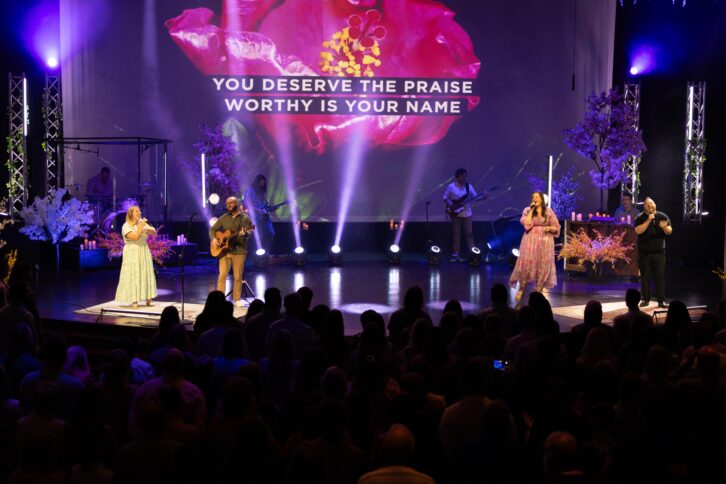 Sometimes a spatial system may create a dramatic aesthetic experience, but it can also play an invisible but crucial role in creating community by bringing people in and helping connect them to their fellow worshippers.
In August, La Croix Church in Cape Girardeau, MO debuted their d&b Soundscape system designed for this important purpose. Installed by Panavid, it incorporates En-Scene, En-Space, and A-Series augmented arrays to address the acoustical challenges of the church’s sanctuary that were inhibiting full participation by congregants.
For years, the church struggled with an aging sound system and an acoustically dead space, the result of an overly aggressive acoustic treatment. The consequences were uneven sound coverage, poor speech intelligibility, and a lack of congregational participation during worship.
“Due to their 19-year-old sound system, the experience for the congregation wasn’t consistent from seat to seat, and because of the lack of reflections in the Sanctuary, the congregation was less comfortable singing in times of worship,” explained Rob Allen, Panavid’s Senior Director of Business Development. “La Croix came to us and asked if we could fix it with a beefier, more modern system. With the acoustic challenges that they had, Soundscape was a no-brainer.”
An old sound system and poor acoustics weren’t the only challenges faced by Panavid. “Their room has tiered seating, so vertical arrays would have introduced sightline issues. Above the stage, there was existing acoustical treatment, HVAC, catwalk, projection, and lights that we had to install around.” said Mike Cirrito, the lead technician on the project. “It was complicated. We were limited to using their existing fly points in the previous speaker locations. That’s why A-Series was perfect for this installation, and ArrayCalc simulation software was indispensable.”
“For the front stage, we went with A-Series because they can fly horizontally, are a third of the size and weight of the preexisting system, yet still drive comparable output levels,” continued Cirrito. “And the hardware accessories offered by d&b audiotechnik provide flexibility in installation. We placed the A-Series where they needed to go, without introducing sightline problems, and we did so efficiently. We were able to hang the three-cabinet center cluster from a single fly point, where the previous setup required three points.” Cirrito also explained how ArrayCalc ensured a smooth deployment and helps ensure the system is best configured to take advantage of Soundscape benefits. “Knowing that there were heavy limitations in speaker placement, we put the exact measurements into ArrayCalc along with the components that we wanted to install. The way ArrayCalc displays coverage patterns and frequency responses in a scenario like this was instrumental. All of that was done ahead of time and then imported into the R1 management software at install.”
In addition to the loudspeaker deployment, Soundscape offered other benefits. The mix separation and depth of field provided by EnScene (along with the overall improvement in clarity from the new speakers) resulted in much better vocal intelligibility for the congregation. The acoustic dryness of the Sanctuary was addressed via En-Space room emulation and further enhanced through the implementation of a voice lift configuration where Panavid hung microphones over the congregation and fed them through En-Space to create a more engaging and participatory experience during worship.
“We chose the voice lift application to improve ambience during worship elements, but we’re discerning in how we use it.” Paul Smollen, La Croix Church’s technical director, explains. ”During the speaking part of the service, we switch En-Space off to give maximum clarity and focus to the pastor or presenter on stage, then when the worship band comes on, we enable En-Space to bring the entire congregation into the experience.”
The complete system included: eight A-Series Ali60 augmented array cabinets and eight flown Bi6 subwoofers for the main L/C/R. Seven Yi10P Y-Series point source were used for the delay ring and side fills. Three 44S point source were installed as front fills, and 31 5S point source were utilized as surrounds. The system is powered by two 40D amplifiers for main speakers and subs; two 10D amplifiers for delays and side fills; and seven 5D amplifiers for front fills and surrounds. Networking and processing are supplied by a DS10 Audio Network Bridge and the DS100 Signal Engine running Soundscape with En-Scene and En-Space software. Seven Audix SCX1 studio condenser microphones were hung in the Sanctuary for the voice lift configuration.
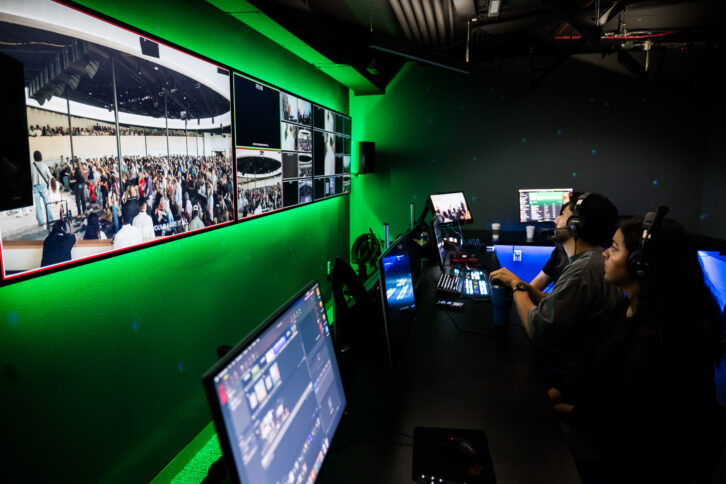 One of the most fascinating aspects of spatial sound is how it can change the physical size and presence of a room to transport people into a distinctive space with a powerful aural atmosphere and meaning. Even more interesting is when that spatial atmosphere is palpable both in-person and for streaming congregants.
Leadership at the newly opened Dallas-based UPPERROOM wanted to transport worshippers to the delay-heavy atmosphere of a cathedral, even though in real life they were gathered in a smaller modern setting. A dynamic church with global outreach, UPPERROOM wanted a compelling audio identity for all its congregants, in person and worldwide, and d&b Soundscape was the key to that.
The audio system, designed and installed by Epic Resource Group, dramatically transformed the acoustics of the church’s reclaimed industrial space, which was designed by Overland Partners, an architectural firm known for delivering transformative, innovative, and sustainable solutions. While Overland provided an impactful design, there were an array of acoustic challenges inherent in the space that needed to be overcome, including: an asymmetrical-shaped room with a glass wall, an overhead circular halo structure over the congregation, an acoustically dead environment, and numerous structural poles that blocked loudspeaker dispersion
Offering ministry 72 hours a week, UPPERROOM’s vision was to create a more intimate and engaging worship environment to better draw attendees into the worship experience. Their goals, however, were not limited to the in-person services. UPPERROOM connects with as many as 10,000 viewers per day on YouTube, and there was a strong desire to enhance the quality of their online ministry, as well.
In working towards a solution to address inperson and online pastoral care needs, it became evident that a Soundscape solution could meet and exceed the UPPERROOM requirements.
A combination of design tools helped provide a working plan. “Designing a system for a space this complicated wouldn’t have been possible without ArrayCalc,” shared Epic Resource Group Founder Brandon Chynoweth. “The software enabled us to quickly envision how acoustic energy would fill the room and guided loudspeaker placement. Once the system was up and running, ArrayProcessing ensured consistent acoustic energy projection across the room. The design of the system’s loudspeakers and subwoofers with their inherent directivity patterns was instrumental in providing low stage volume, resulting in clean, high-quality live recordings.”
The lynchpin of the installation was Soundscape, which helped solve the room’s most vexing acoustic problem, its twelve support poles. “Any stereo iteration I considered always had a pole about 3 feet in front of at least one speaker. The En-scene module on Soundscape provided the only answer,” affirmed Matt Wheeler, Epic’s senior audio systems designer. “The elegance of the Soundscape’s object-based mixing means a single loudspeaker doesn’t have to do all the work. En-Scene minimized shadowing from the room’s support beams, ensuring adequate coverage of the entire room. Now, you don’t hear the obstruction from the poles; sound appears to pass right through them.”
With En-Scene addressing the room’s acoustic challenges, En-Space room emulation opened up further possibilities. UPPERROOM’s Global Audio Director, Brandon Meyer elaborates, “En-Space is the key to making everything sound as good as it does. The natural reverb time of the room is less than half a second, but with the Basilica emulation, we can create an acoustic space with up to a six-second reverb tail.” Meyer continues, “Although we’re not physically in a huge cathedral, acoustically we are. Best of all, front-of-house engineers can apply processing to specific elements or sources within the mix. Then when the pastor speaks, the message can be more tightly focused and sound like he’s speaking directly to you.”
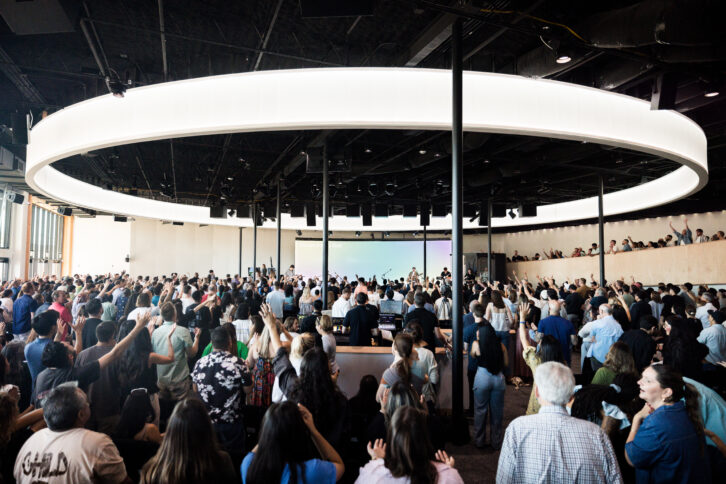 Congregants affirm that feeling of being more deeply connected and immersed in the worship services. As Jonathan Lewis, executive prayer and worship pastor, shared, “It’s like you’re in the middle of the experience and you’re part of it.” Lewis also reports that the system has elevated the quality of UPPERROOM’s live recordings and online broadcasts. “We didn’t just get a new sound system, we’re thrilled to have a ‘recording studio,’ too,”
The immersive nature of UPPERROOM’s new location has also contributed to a growth in attendance. “Since we’ve opened the space, what’s transpired since has been really special,” said Meyer. “People don’t know what they’re hearing, they just know they like it. Sunday’s services hit capacity and nearly doubled the attendance of our previous location. In fact, we’ve added another service on Saturday to accommodate everyone who wants to be a part of our worship experience.”
Epic’s Chynoweth concludes, “When you connect with people that deeply, your retention rate is much higher. If you’re focused on what that means for growing your church, spreading the word, making meaningful experiences in people’s lives, and keeping them engaged, Soundscape is a relatively small investment for the outcome it helps provide.”
The Soundscape 360 system features the DS-100 Signal Engine combined with 117 d&b loudspeakers installed in the facility. The front 180 degrees utilizes five compact T-Series line arrays, with each array comprised of six T10 enclosures. Flown in between the T-Series arrays are twelve V-SUB subwoofers, which combine with 9x ground stacked 21S-SUB subwoofers for low-end support. Thirteen xS-Series 44S enclosures are used as front fills, while six individual A-Series augmented array boxes comprise the inner surround ring, and nineteen E-Series E12 point source loudspeakers complete the outer surround ring. Five Y-Series YiP10 point source loudspeakers fulfill extension duties, and five T-Series T10P enclosures provide delay coverage for the oval-shaped ramp that leads to additional seating
Since its founding in 1976, Westside Family Church, a multi-site Southern Baptist congregation in Lenexa, Kansas, has embraced change to best serve its community, so it’s perhaps not surprising that last year, they made the move to incorporate L-Acoustics L-ISA immersive sound technology into their worship experience.
The L-ISA immersive platform debuted in 2016 and expanded to include the Hyperreal Technology for precisely locating sound and L-ISA Studio for creators to mix object-based audio.
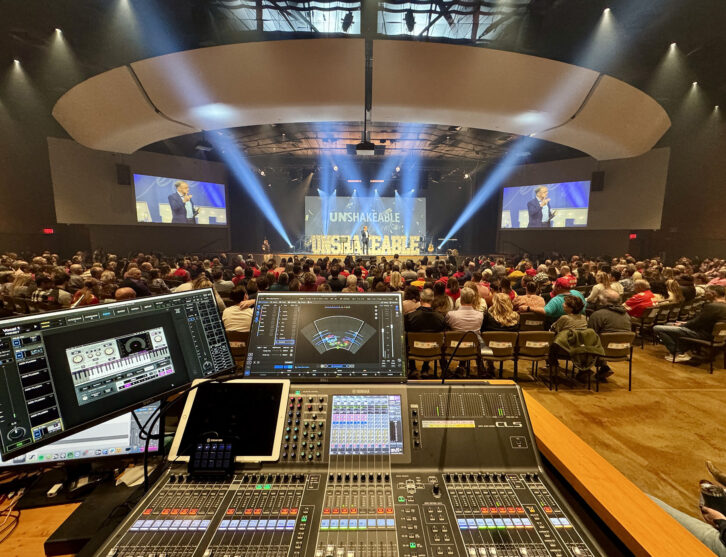 “The Westside design presented several unique challenges,” explains Marc Breda, Project Lead at Vantage Pro AV, the church’s integration and technology partner. “First, the main worship space has an unusually low ceiling for a room of its size. We also had to work around a centrally located catwalk that further limited our usable trim height. Additionally, the church uses a large 34-foot-by14-foot projection screen for their services, so maintaining clear sight lines for important visual content throughout the seating area was crucial.”
Using L-Acoustics Soundvision 3D audio modeling software, the correct solution quickly proved to be an L-ISA design utilizing A10i as the primary loudspeaker. A mixture of both Wide and Focus models comprise the main Scene array, buttressed by KS21 subwoofers, with everything powered by a pair of LA7.16i amplified controllers.
“The new system nicely fits the room’s geometry,” he says. “It’s a moderate fan shape with stadium seating in the back, which lends itself well to an L-ISA design. There’s a little bit of extension seating out to the wings of the main floor, and we had to bring the main speakers a little lower in order to shoot up underneath the catwalk, but ultimately, everything fit perfectly.”
That would have been enough for almost any church, but Westside Family Church also wanted to enhance the audio experience, says Vantage Pro Audio Team Lead Duke DeJong—and that meant immersive. “It’s been fun to watch their tech staff really lean into the L-ISA immersive technology,” he says.
“Houses of worship are embracing immersive sound for both creative and practical reasons,” explains DeJong. “While many are excited about the enhanced mixing capabilities and more immersive worship experience, there’s also a practical driver behind this trend. Traditional line arrays can protrude ten feet or more from the ceiling, creating visual obstacles. Interestingly, aesthetics have been the initial catalyst for all our L-ISA installations,” he adds. “
The impact of L-ISA technology extends beyond better sound—it can transform how worship teams engage with their ministry. For Obed Castillo, Westside Family Church’s longtime AVL Engineer, the difference was profound enough to bring him back to the mixing console. “With our previous system, I had stepped away from hands-on mixing because the lack of clarity made it difficult to distinguish frequencies,”
Castillo explains. “But L-ISA completely changed that. The clarity is exceptional—even subtle EQ adjustments are immediately noticeable. Plus, the system’s localization capabilities give me new creative options. Instead of relying solely on EQ, I can enhance elements in the mix by adjusting their spatial positioning. The results have been so inspiring that I’ve gone from mixing just three services a year to being at the console any time a volunteer is not available, and I can step in at front of house.”
The intuitive nature of L-ISA technology has proven particularly valuable for Westside’s volunteer audio team. “The system is remarkably user-friendly, especially with the comprehensive training provided by L-Acoustics staff,” Castillo shares. He cites an unexpected success story: when one of the church’s video operators attended the training sessions and created a practice mix at home, the results were impressive. “Their mix had a unique visual perspective, making creative use of the spatial capabilities. Despite coming from a video background, they produced excellent sound. This really demonstrates how intuitive L-ISA is— making immersive audio mixing accessible to our entire production team.”
On the creative side, L-ISA offers the church new capabilities that are changing the way it presents its messaging. “It has us thinking in a different way about sound and presentation,” says Derek Davis, Worship & Creative Arts Director. “Now, we have a variety of options that weren’t there before. For instance, we can pan any instrument or person to any part of the stage, and everyone listening will perceive the sound to be at that place onstage, no matter where they’re actually sitting. We can pan hard left or right, and everyone will hear it clearly.”
“We’re taking a methodical approach, using weekdays to explore L-ISA’s extensive capabilities and fine-tune them for our Sunday services,” Davis explains. “The system offers so many creative possibilities that we’re discovering new ways to enhance our worship experience every week. The results we’ve already achieved are incredibly rewarding, and we’re excited to continue exploring L-ISA’s full potential.”
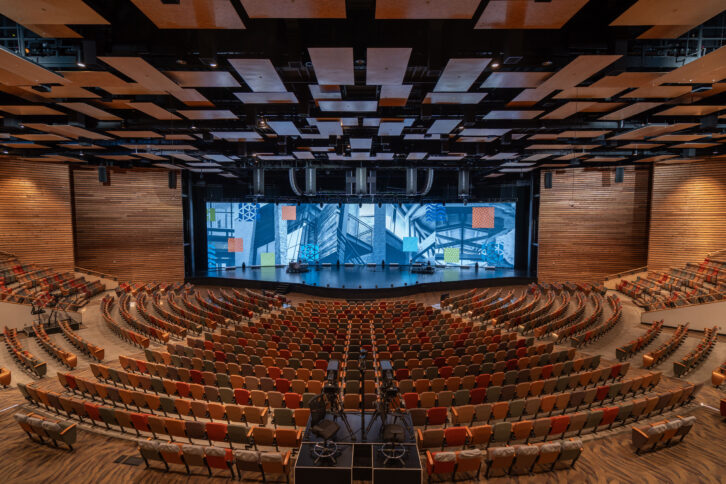
For churches with videowall centerpieces, spatial audio can play an important role in maximizing the impact of the video. The most recent L-ISA worship installation for Dallas-based Watermark Community Church is one of those examples with multiple campuses and over 9000 weekly attendants.
For years, it has been an L-Acoustics user, starting with a Kudo PA system that served them well for more than a decade. This year, Watermark headed into its next chapter with the adoption of L-ISA Hyperreal Sound technology with L-Acoustics L Series loudspeakers, sold and installed by Clark, an integration company based in Alpharetta, Georgia
“Watermark is definitely unique,” says Clark Business Development Executive Noah Hawley. “The moment you walk in, you are riveted by the church’s nearly 100-foot-wide video wall made up of more than 1,000 half-meter-square LED tiles. And that massive scale is indicative of how they approach music and video production – there’s a lot of creative horsepower at work there. But amazing visuals aside, the single most important element in a house of worship is the sound, being able to effectively communicate the message to everyone in attendance.”
The church’s recent switch to L-ISA paired with L Series arrays has provided improved intelligibility and fidelity throughout the entire seating area. The main Scene system is comprised of five arrays of one L2 over one L2D. Four Extension arrays to the far left and right are made up of Kiva II, with eight enclosures per hang closer to the Scene system and seven enclosures per hang further out. Arrays of 10 Kara II each provide out-fill, with low-end coming from a center deployment of 10 KS28 subs flown in two hangs of five KS28 in cardioid mode
Seventeen compact coaxial X8 enclosures are evenly distributed across the lip of the stage for spatial front-fill, while three KS21i subs per side are mounted into the face of the stage to supplement the room’s low end. Arrays of two A15i Wide per side provide extreme left and right over-balcony delay, while a dozen X8 serve as under-balcony delays. The entire system is powered and processed by 16 LA7.16i amplified controllers and three LA12X. These are driven via Milan-AVB with L-Acoustics LS10 switches, while an L-ISA Processor II with a 64-output license is driven over MADI from the church’s SSL L350 Plus FOH console.
Hawley says the sanctuary’s acoustics are magnificent. “Coupled with the acoustics and L-ISA, for the first time everybody could see, wow, this is how the room is designed to be heard,” he says. “This is what the intended experience was supposed to be. Now the room’s complete, the vision’s been accomplished.”
“While I think most people don’t really understand what a spatial system does, they do know that it sounds clear and amazing, which is what we were shooting for,” says Bekah Winans, Watermark Community Church’s Audio Director. “They’re now able to pick out distinct instruments instead of just hearing a wall of sound.” She adds that the use of L-ISA technology has dramatically expanded sound coverage in the room, with at least 80 percent of the seating areas getting a fully immersive experience.
Operationally, L-ISA easily integrates into the church’s workflow, and can be controlled via either an external L-ISA Controller display or directly from a touchscreen of the SSL house desk. But the greatest accomplishment has been the enhanced sense of community with L-ISA, making the venue feel more intimate, says Hudson Horsley, the church’s Systems Engineer. “Whereas a lot of other systems divert attention to the speakers, L-ISA pulls your attention to the stage, and connects the audience with the communicator.”
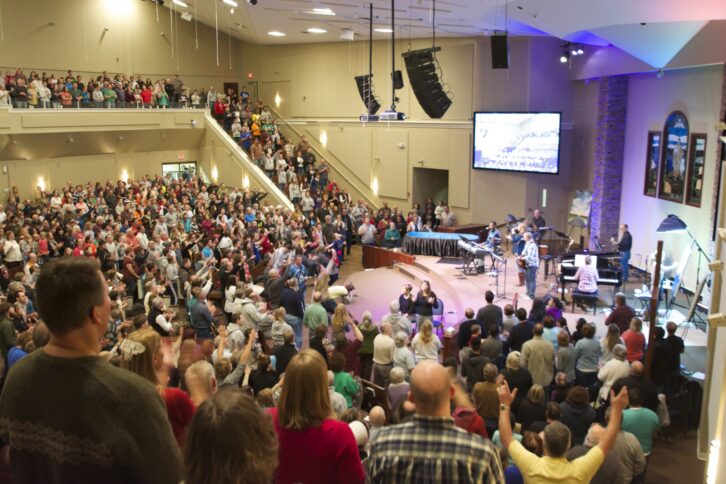 An undisputed pioneer in spatial audio, Meyer Sound supported what must be one of the first use of it for worship. Eleven years ago, Constellation supercharged congregational singing for the Clinton Frame Mennonite Church in Goshen, Ind. (below)
Constellation was developed under the leadership of Steve Ellison and based on the patented VRAS (Variable Room Acoustic System) technology developed by Dr. Mark Poletti. It gives venues the ability to modify their room acoustics at the press of a button, allowing them to host a wide range of events and provide the acoustics most appropriate for them. For churches it allows them to create the ideal sonic characteristics for congregants to feel immersed and join in.
“The first time Clinton Frame used Constellation, the congregation sang ‘It is Well with My Soul’ acapella, and when they were done, everybody burst into applause,” recalls Doug Hood, president of Fort Wayne-based CSD Group, which provided and installed the Constellation system. “I was told that this sense of total engagement hadn’t happened in the church for years.”
The Constellation system at Clinton Frame’s 1,000-seat sanctuary was configured with multiple acoustic presets, four of which are primarily used for worship, with about six changes made during a typical service. That system was built around a D-Mitri digital audio platform that hosts patented VRAS acoustical algorithms. Acoustical ambience was captured by 23 miniature cardioid microphones, and the enhanced acoustical response was delivered through 81 MM-4XP self-powered loudspeakers, eight UPM-1XP loudspeakers, and twelve MM10XP subwoofers.
“During services when the worship team sings through the PA, we turn on Constellation, and the crowd response keeps building as they join in,” reported Joel Miller, head sound technician at Clinton Frame at the time. “This folds back energy to the stage, and it just goes back and forth and gets stronger and stronger. The worship teams are just soaking it in and saying, ‘Wow, we can’t believe this is happening.’
“We installed Constellation for acapella singing, but we didn’t expect how much better speech would sound with a subtle blend of early reflections, and how the right setting could improve a musical performance by the worship band.”
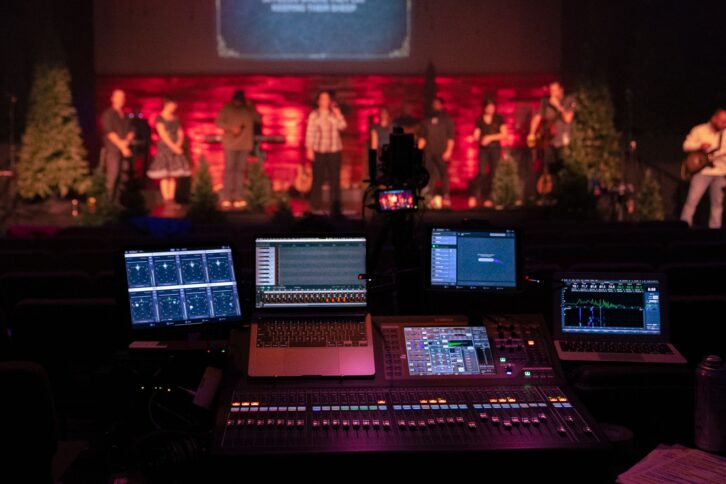 Since then, other churches have incorporated the technology, and Meyer Sound has gone on to bring another spatial tool to fruition, Spacemap Go, a design and mixing tool for 3D audio. The seeds of Spacemap Go iPad app reach back over three decades; it was formally launched by Meyer in 2020, in the process, turning every GALAXY processor into a potential spatial audio engine and opening up a broad vein of applications worldwide.
On the worship front, Good Shepherd Church in Naperville, IL (above) deployed Spacemap Go to create a 3D audio experience for the church’s annual holiday show, “Encounter Christmas.” The system for the show, designed to cover a 400-seat black box worship space, was composed of 10 ULTRA-X40 compact loudspeakers, two ULTRA-X20 compact wide coverage loudspeakers, four 900-LFC compact low-frequency control elements, and two Galileo GALAXY Network Platforms. The deployment allowed the FOH engineer, Brian Rutter, to map each of the 16 GALAXY inputs around the room to create an immersive experience that used Spacemap Go to supersede what could be done with the traditional stereo line array system normally installed in the room.
“The benefit of an immersive deployment is that we no longer have to play the ‘sweet spot’ game where the listener needs to be equidistant to the left and right speakers to get a good image,” said Andrew Dewar, Good Shepherd’s Technical Director. “With an immersive system, where every speaker covers the entire audience, every seat in the house is sweet.”