There is perhaps no greater role for AV in worship than to support intelligibility. There are many obstacles to that mission—poor acoustics, historical buildings, modern buildings, styles of worship, congregational demographics, budgets, glass, and many more. Here are some recent examples that demonstrate how intelligibility was created through a combination of hardware, software, and expertise to produce results that transcend technology.
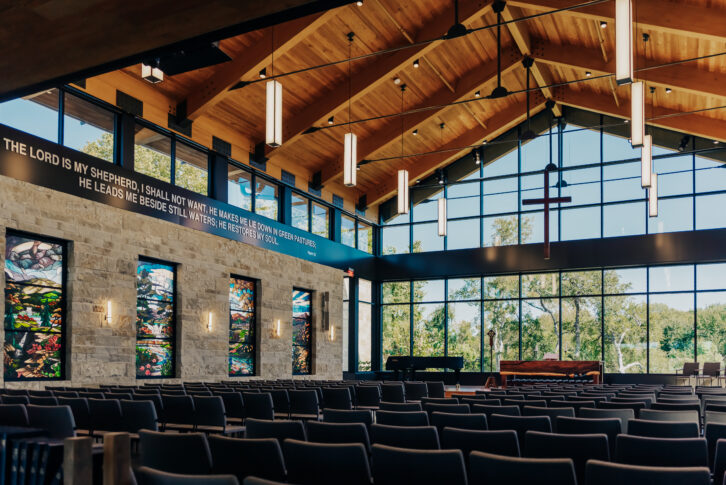
Hasley Chapel, a new worship space nestled in the northwest corner of St. Andrew Methodist Church’s campus in Plano, Texas, was built with both visual and aural aesthetics in mind. Designed by Dallas-based architectural firm GFF, with audio system specification and installation provided by local integrator Clear ProAV, the picturesque chapel overlooking a pond and wooded area now routinely hosts a mix of traditional worship services, weddings, memorials, small conferences, and other events.
Compared to the church’s primary worship hall, which hosts both contemporary and traditional music services, Hasley Chapel is more intimate, seating 120 people on the main floor and featuring a balcony that can accommodate a modest choir or audience overflow. But despite its diminutive size, the space presented some sizable challenges, says Clear ProAV Systems Designer Chad Fuller.
“The look and feel of the chapel is beautiful, but there are a lot of reflective surfaces,” Fuller observes. The area behind the stage is all glass, while the stone side walls have windows, and the building has a high-pitched roof. “It’s a traditional design, but with a modern take, and the aesthetics are huge. So everything we did, especially with the audio portion, had to fit into that. We really had to think about the system design from an ideal performance and coverage perspective, but in a way that would not detract from the beauty of the room.”
Hasley Chapel’s solution came in the form of two colinear L-Acoustics Syva enclosures as the main left and right components of the PA. The Syva are RAL color-matched to visually melt in with the gray stone interior side walls where they are mounted, helping obscure the overt presence of audio technology in the room.
St. Andrew Audio Manager Ryan Mansfield appreciates how the loudspeakers don’t stand out. “We also have two discreet Syva in our main building that we use for a side front-fill area, to bring the image down in our sanctuary,” says Mansfield. “They’re very visually unobtrusive and offer great coverage for that space.”
Six ultra-compact X4i coaxial enclosures are used for front-fills, installed within the second step of the stage at the front of the room. Clear ProAV coordinated with GFF to get the architectural clearance to insert the speakers behind custom screens. For low-end reinforcement, a pair of L-Acoustics Syva Sub and Syva Low enclosures on each side of the stage round out the frequency spectrum. These were chosen for their ability to deliver a solid low-end presence from a low-profile cabinet. Furthermore, two L-Acoustics X8 are surreptitiously mounted to a ceiling beam in the balcony, up with the lighting fixtures, providing coverage for that area when it seats a choir or churchgoers.
 With so much glass and stone throughout the venue, sound reflections were obviously an initial concern, but the L-Acoustics systems offered Fuller and his team control in terms of speaker placement, dispersion, and tuning. With no sound-dampening treatments done to the room, Clear ProAV needed to be very specific about system deployment, and L-Acoustics Soundvision design software offered both the contractor and client a high level of confidence in the final design prior to the construction and system integration taking place.
“We were able to work with the architect during the chapel’s early planning stages to mitigate some potential issues,” says Fuller. “For example, we were able to request that the glass in the balcony be angled just a touch to avoid bad reflections bouncing back toward the stage. Soundvision was instrumental in helping us determine where we could position our loudspeakers.”
“The chapel has pretty decent acoustics, and can be used without reinforcement, but the Syva system adds a nice extra bit of clarity and presence, helping everything feel even more natural,” explains Mansfield. “It can be used quite sparingly to make the room sound nicer, but it’s also great when we push it as well. Everything is easy to use and sounds beautiful.”
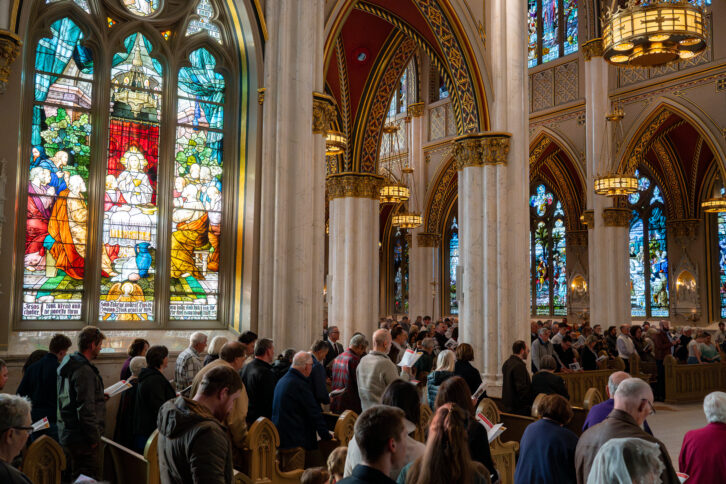
The majestic Cathedral of St. Helena is a cornerstone of the Helena, Montana community. Last fall, an upgrade designed and installed by Montana Pro Audio overcame the inherent acoustic challenges of the highly reverberant 116-year-old church to achieve what is described as unprecedented vocal clarity and intelligibility for its congregation. As preserving the cathedral’s historic aesthetic, which features stone walls and scagliola columns, was paramount, it required specialized mounting and integration, with a customized paint and finish solution from d&b.
For the church, the audio upgrade wasn’t merely an improvement: “If people can’t hear well in the cathedral, they can’t understand the message of the gospel, and they can’t respond in faith,” explained Father Marc Lenneman, Pastor/Rector of the Cathedral. “This audio upgrade was absolutely necessary and the easiest money I’ve ever spent.”
Built in 1908, the Roman Catholic Cathedral of St. Helena evokes the “awe and beauty of European cathedrals,” with architecture, tile flooring, stone walls, scagliola columns, stained glass windows, and a nave ceiling estimated at 60 feet high, creating that highly reverberant environment.
The previous sound system, installed in 1985, attempted to remain unseen by hiding speakers within chandeliers, a creative solution for its time, but one that offered poor clarity and sound quality. Montana Pro Audio faced a daunting task of achieving high intelligibility in the space. To achieve the desired results, Montana Pro Audio utilized a distributed audio approach, “We opted to use more speakers with less amplitude,” describes Aaron Fisher, business development manager for Montana Pro Audio. “By having the sound emanate from more points within the space, we ensured consistent coverage and intelligibility.”
The proposed d&b audiotechnik solution features xC-Series cardioid columns (6 x 24C, 2 x 24C-E, and 10 x 16C) and xS-Series point sources (14 x 4S and 2 x 5S). Having seen the effectiveness of column loudspeakers in similar European churches, Father Marc was immediately receptive to the xC-Series based design.
Prior to the installation, a critical step in gaining acceptance for the audio upgrade was winning over the congregation. Father Marc insisted on the congregation buying into and “understanding what they were planning…after all, this was their church and the money they donated.” Montana Pro Audio demonstrated this by switching between the existing system and a subset of the planned system.
“I began speaking the psalm from our most recent mass and switched over to the new system. There was shock, everyone gasped, then they started clapping,” Father Marc recounted. “We also demonstrated the system with a cantor and organist, and after that, there was no clapping, it was silent. The beauty of the human voice lifted in prayer to God, so clearly and beautifully augmented so that everyone in the cathedral can hear, helps others pray. That’s the purpose of our cathedral, and that’s what the power of a good sound system can do.”
Once the sound quality and intelligibility challenges were addressed and the church agreed to the proposed solution, the next objective to solve was to keep the installed loudspeakers unnoticeable. To achieve this, Montana Pro Audio worked closely with the d&b audiotechnik Custom Solutions Team, which specializes in fabricating special hardware, weatherization, and unique aesthetic features.
“d&b’s custom shop was the key to preserving the cathedral’s appearance,” said Fisher. “They were able to provide the loudspeakers and hardware in a custom vintage white color that matched the hand-painted columns resembling marble. The custom shop did such a great job; if you don’t know what you’re looking for, you can’t even tell there are speakers in the space.”
While the system design and color matching were relatively straightforward, the physical constraints of working within a historical building with areas affected by past structural damage (a 1935 earthquake and a train derailment in 1989), proved to be the most challenging aspect of the installation.
“The installation process was quite difficult,“ commented Fisher. “Running wire to each speaker involved going into the basement and drilling up into the interior cavity of each column for every speaker location. This required connecting nearly eight feet of drill bit extensions together.” In addition, the unique shape of the pillars posed another challenge that necessitated custom hardware to create a flat surface for mounting the speakers.
Once the cabling was run and the hardware mounted, the rest of the installation process went smoothly thanks to d&b audiotechnik ArrayCalc software. “The accuracy of ArrayCalc software for design and time alignment is remarkable,” said Fisher. “It made the tuning of the system seamless and efficient. We were able to turn the system on and get it going very quickly once the physical installation was completed.”
With the new audio system fully functional, congregation feedback has been consistently positive. “People are so thankful that they can hear clearly now, regardless of where they are in the cathedral, from the main level, to fill areas like chapels, the altar, and the choir loft,” said Father Marc, who also noted that during record attendance at Easter, “even people standing outside the great front doors could still hear, thanks to speakers in the narthex.”
The new system has also impacted Father Marc’s preaching: “With our old system, there was such a lack of clarity, people constantly said they couldn’t understand what I was saying,” shares Father Marc. “I was forced to speak slowly and deliberately, but now I feel I can communicate more naturally and dynamically, knowing that people can understand me. Now even when there’s the normal distraction of little kids or other people around them, people do not lose the message, and that makes all the difference in the world.”
 The “heard but not seen” objective of the audio upgrade was also successful. “Our bishop wasn’t present when the installation occurred,” said Father Marc. “I sent him photos, and he asked, ‘Where are the speakers?’ and I thought, ‘Perfect. Mission accomplished.’ Even my mother doesn’t know where the speakers are. She can’t find them.”
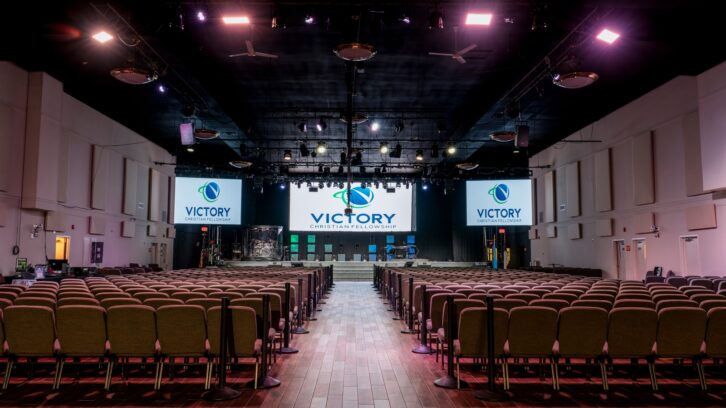
Victory Christian Fellowship, a 1,000-capacity church in New Castle, DE, had struggled for decades with intelligibility and uneven coverage despite upgrades to consoles and acoustical treatments. The church’s 70-foot-wide by 100-foot-deep sanctuary hosts contemporary Christian worship, touring artists, large conferences, and major productions, including Christmas plays and a New Year’s Eve celebration that fills every seat. According to Tyrone Dinkins, the church’s media director and a classically trained musician, the previous system couldn’t keep pace.
“The speakers were just tired,” says Dinkins. “It became more of an assault on my ears than a pleasure to listen to. No amount of EQ could bring back the clarity that was missing. Even a simple classical guitar performance was frustrating because the midrange just wouldn’t articulate correctly. It was time for a real upgrade.”
Dinkins, who holds multiple music degrees and brings a performer’s ear to every decision, turned to DBS Audio Systems and personally led a competitive evaluation process. “What really convinced us was hearing Meyer Sound systems in other venues, and knowing DBS Audio was installing them at the Academy of Music [in Philadelphia] and other world-class spaces,” he explains. “If Meyer Sound is good enough for those environments, we knew it would deliver for us.”
DBS Audio President Dave Brotman, who has worked with Meyer Sound systems for more than 30 years, recommended a point source solution based around ULTRA-X80 versatile point source loudspeakers. “The old system had two delay zones with no time alignment, creating one giant reflection,” says Brotman. “No matter what they tried at the console, they couldn’t correct the massive underlying issues.”
The new system comprises left and right mains of ULTRA-X80 loudspeakers, supported by two 2100-LFC low-frequency control elements, four ULTRA-X20 compact point-source loudspeakers as front fills, and two delay zones of ULTRA-X40 compact point-source loudspeakers (two in each zone). Processing is managed by a Galileo GALAXY 816 Network Platform.
To guarantee optimal results on the compressed installation timeline, Brotman collaborated with Meyer Sound’s Director of System Optimization, Bob McCarthy, who developed the system design. “Bob’s expertise ensured everything was precisely aligned from the start,” Brotman notes. “The ULTRA-X80 is like a PANTHER in a trapezoidal box. Paired with the 2100-LFC sub, the result is the most musical low end coupled with the fidelity of a PANTHER in the new ULTRA-X80. We weren’t sure we could even get the subs in at first, but with careful measurements, we slid a 2100-LFC under each stage platform with just a quarter inch to spare, and they complement the ULTRA-X80s beautifully.”
For Victory’s senior pastor, Dr. Gary Whetstone, the change has been profound.
“The difference is like night and day,” he says. “The purpose of preaching is for people to hear, understand, and engage with the word, and this system finally allows that to happen. Our congregation isn’t just hearing volume, they’re hearing clarity—and I haven’t heard a single complaint since the install.” Dinkins adds that the impact extends behind the scenes. “Our engineers really enjoy it because they’re remixing in a different way. They have true control.”
Even the congregation is responding in ways beyond words. “Watching people interact differently with the sound was more telling than what they would say,” says Dinkins. “You can see the smiles. That says it all.”