The world-famous Science Museum in London aims to inspire visitors with award-winning exhibitions, iconic objects and stories of incredible scientific achievement.
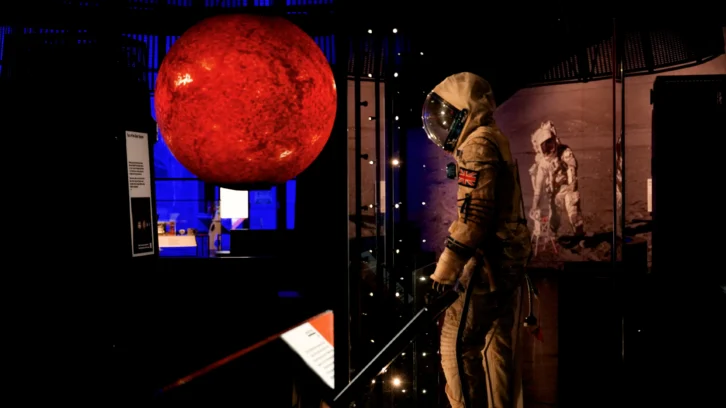
Among its wide-ranging attractions, the museum has recently opened a new Space Gallery to the public. This ground-breaking gallery showcases new technologies from the UK space sector, on display for the very first time, including prototype propulsion technology from Magdrive, as well as international innovations, such as the ‘rolly-polly’ Moon rover – the result of the first collaboration between a space agency and a toy company.
When the museum decided to redesign and relocate its existing ‘Science on a Sphere’ exhibit into the new Space gallery, there were technical challenges, including the need to re-house existing media servers, which had previously been concealed behind a wall and were in a location ill-suited for maintenance. The new space required the servers to relocate to a bespoke, climate-controlled comms room at the other end of the building.
The creative exhibit would need to integrate four projectors to create a seamless image on a floating sphere. Any new setup had to keep all four video streams perfectly in sync over IP, while also preserving image quality so visitors would not see stutter, drift, or misalignment as the sphere rotated.
Another key part of the project specification was a decision to migrate the underlying digital infrastructure to AV over IP, while staying within the museum’s existing network capacity. This needed a solution that could deliver synchronization and quality without requiring a high-bandwidth SMPTE 2110 network.
The museum selected Matrox Convert IP encoders/decoders using IPMX over its standard IT network, allowing AV sources and displays to be located in different parts of a building while still behaving as if they were directly connected.
IPMX met the museum’s technical requirements without requiring a high-bandwidth SMPTE ST 2110 network, enabling it to operate within the museum’s existing network capacity.
To display the imagery, Panasonic projectors with Matrox ConvertIP SDM modules were used, integrating IP decoding directly into the displays. The four video streams from the server room were compressed, transported over the IP network, and decoded in the projectors via ConvertIP SDM, rather than being generated locally in the gallery.
Described by Time Out as a “must see,” in the Space gallery visitors can fully immerse themselves in the content without being distracted by technical issues such as stutter or latency. As planned from the outset, the technology effectively “disappears”, allowing the focus to remain on the science and storytelling displayed on the sphere.
The museum’s technical team can now operate and support the exhibit more easily and reliably from elsewhere in the building, having been freed from the restrictions of the legacy infrastructure. By using less hardware, the museum has reduced potential points of failure, thanks to the use of the ConvertIP SDM modules integrated into the projectors.