Traditionally strictly the muscle end of any sound system, power amps were for ages just big dumb, heavy brutes. Users plugged them in and they either worked or they didn’t. Now, the power amp has evolved into a system within itself with logic, networked control, self-diagnostics and security, all contained and operating in sync within the unit. Many modes of operation can be configured to blend the new features with the needs of a wide range of sound systems. The models noted here illustrate the new trends in ever-smarter power.
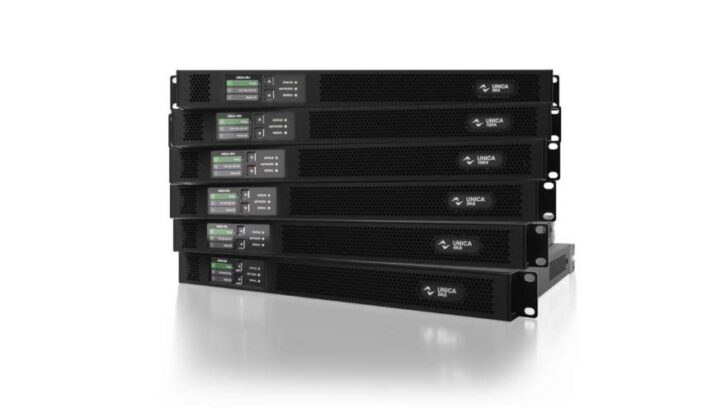 This year, Powersoft debuted the most advanced amplifier platform in the company’s 28-year history. Backed by 13 patents, Powersoft UNICA leverages next-generation, cloud-based technology to provide a safe, consistent user experience for any size of install. An all-new power supply section and power-sharing features take Powersoft’s signature efficiency to the next level. The platform also includes new DSPs, based on system-on-chip technology. The DSP section is operable even when only PoE+ power is available. On a firmware-level protocol, audio over IP is managed through both Dante and AES67, and networking is achieved through three ethernet ports, allowing both AoIP and control redundancy and splitting control vs AoIP traffic. Compatible with ArmoníaPlus and third-party integration and integrated with the new Universo cloud control and monitoring software.
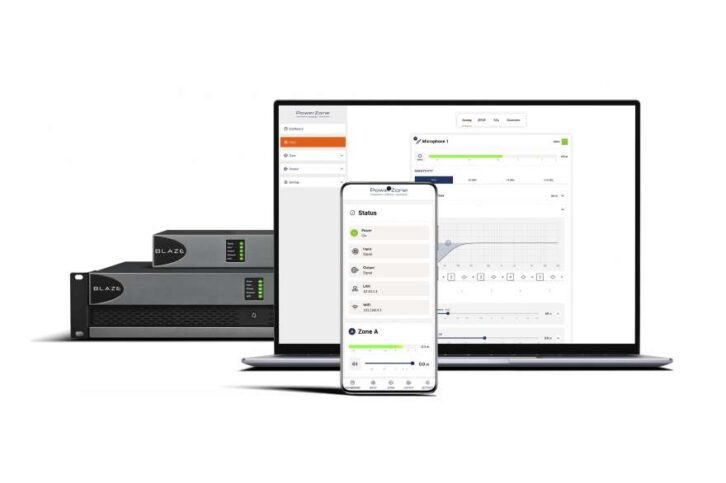
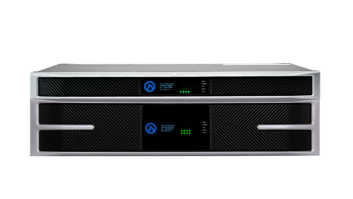
The Blaze Audio PowerZone Connect series is a line of DSP-enabled Class-D amplifiers designed to make system installers’ lives easier with reliability and efficiency, along with exceptional system configuration. Total system power across the range consists of model outputs from 125W to 3000W. The PowerZone Connect series powers both conventional low-impedance (2 to 16 ohms, model dependent) loudspeakers and constant voltage (70V/100V) transformer-coupled loudspeakers. All units feature automatic power-sharing technology for proportional distribution in both Lo-Z and Hi-Z modes offering ultimate flexibility. Complementing the PowerZone Connect series amplifiers is an initiative control web app, PowerZone Control. PowerZone Control facilitates effortless customization of even the most challenging audio/voice systems by delivering many DSP configuration options and tuning features, including multi-zone setup, input mixing, priority and ducking, restriction, input, and output EQ, S/PDIF output routing, high-pass filter, speaker presets, delay, Wall-S1 controller configuration, Sine generator, and much more. PowerZone Control is embedded in the PowerZone Connect full Matrix DSP amplifiers and can be accessed from any device and browser via the PowerZone Connect built-in Wi-Fi or RJ45 network port. Integrators can connect the amplifiers to an existing network and access the units from anywhere in the world.
 Efficiency and dependability were the targets in the design of the Ashly Audio CA-1.54 four-channel amplifier as part of the famed CA Series. Two of these Class-D units, each providing 6000W, can be operated on a single 20-amp service. On the front panel are LED indicators for Temp, Current, Input signal (-45dB) and Clip/Mute (one for each channel) along with Protect Mode and Disable. The rear panel is equipped with 3.5mm removable balanced Euroblock connectors for each input in addition to an XLR/TRS 1/4in. combo jack.
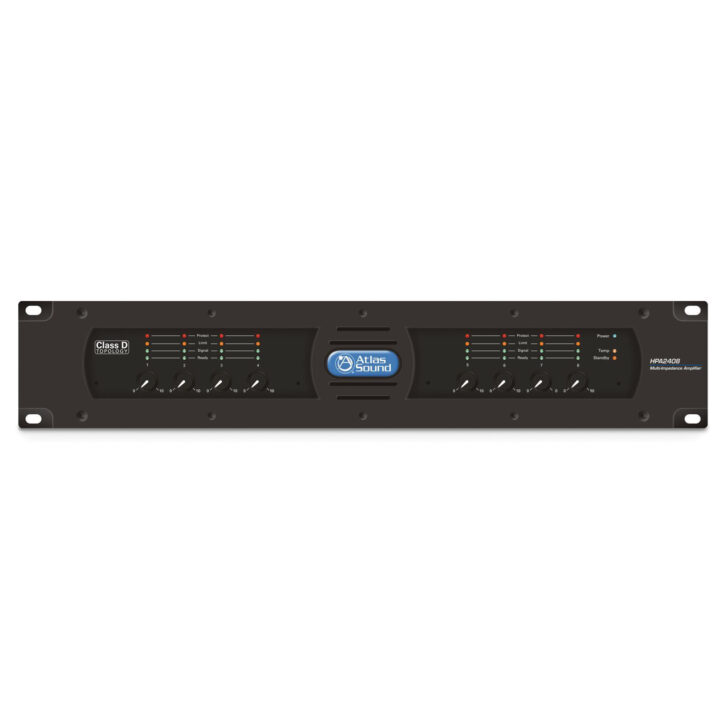 For precise control of more sound zones, the AtlasIED HPA2408 provides eight channels and a total of 2400W through a Class AB design. This versatile amp can operate in 25V/70V/100V distributed environment or used for low impedance 8 or 4-ohm applications. HPA amps are energy efficient and meet Energy Star 1W standby mode standards. Each channel load can be independent of the others and there are Stereo and parallel operating modes. Multistage fan cooling, selectable input sensitivity, and removable air filters are additional features.
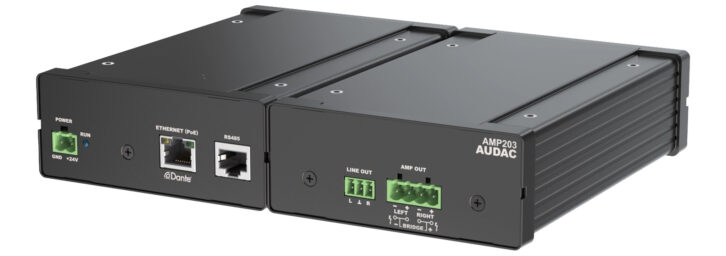 The AUDAC AMP203 has the smaller end of amp applications covered with its Dante/AES67 digital audio input, advanced DSP and loudspeaker management, Ethernet and RS-485 control as well as PoE 802.3bt powering capability. This amp can distribute uncompressed audio via standard Ethernet networks with near-zero latency. All configurations can be made in the AUDAC Touch 2 system control platform. By way of its 4-pin terminal block connector, the AMP203 delivers 30W per channel or 60W when bridged.
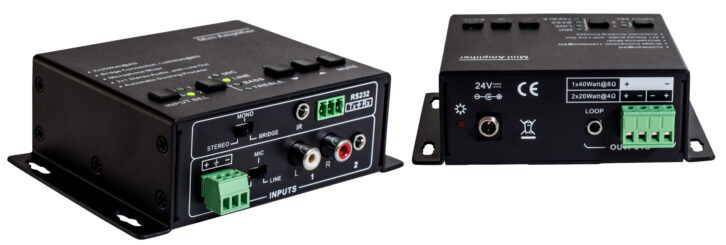 Versatility in a mini-box describes the Aurora AS-AMP1 with its two selectable inputs, treble and bass control, mute button, and auto-ducking function. This tiny Class-D unit can operate in bridge or dual mono mode and its control extends to RS-232 with smart feedback. The internal international power supply allows it to power up anywhere. Either selected mic input can be mixed with the line output. This amp puts two 20W channels into a 4-ohm load.
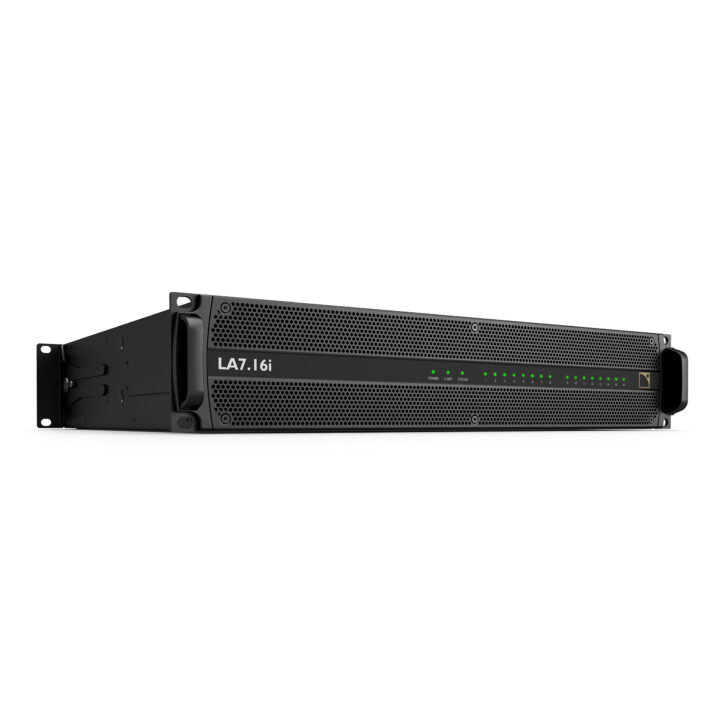 Launched at InfoComm last year, the L-Acoustics LA7.16i amplified controller surmounts the limitations of current high power amplifier configurations used in most installation projects. Unique in the market, LA7.16i offers a 16×16 architecture in a 2U chassis with Milan-AVB redundancy. Each of the 16 output channels delivers up to 1300 watts at 8 ohms or 1100 watts at 4 ohms. At InfoComm 23, it will be joined with a similarly high-density touring model, the LA7.16.
 The Crest Audio Pro 9200 holds sonic accuracy as its top priority and its exclusive IGM circuit enables the Pro 200 Series to drive 2-ohm loads safely without compromising performance. This produces up to 3250W at 2 ohms per channel. Clean audio signal comes in on balanced inputs with input sensitivity selection while dual, variable speed fans maintain cool running. Stepped attenuators are recessed and there is a mode selector switch for stereo, parallel and bridged-mono operation. Output is available on two Neutrik SpeakON NL4 terminals as well as twin binding post connections.
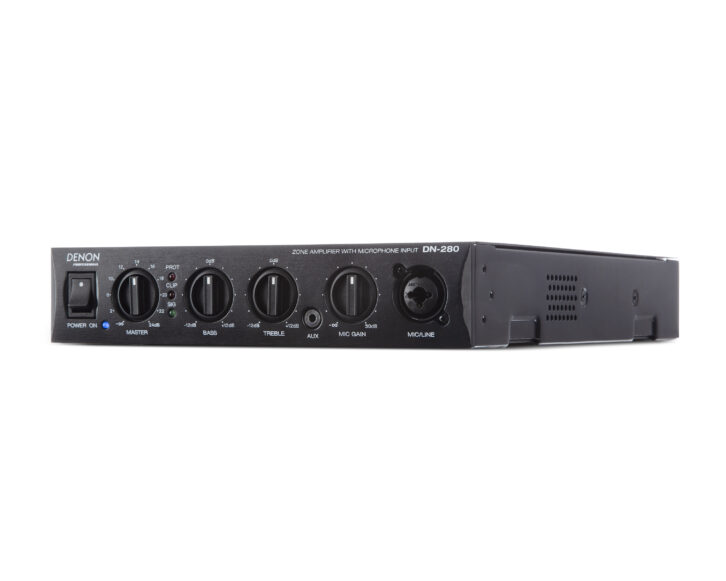 The Denon DN-280 zone amp allows the user to pack a lot of power into a small space while maintaining a conventional looking control surface. Capable of summing stereo signals into a mono output for paging, P.A. announcements and background music applications, the DN280 occupies only a half rack space and it provides a convenient direct microphone input. This unit can be installed into an existing 8-ohm or 70/100V speaker system to provide 100W power with a signal-to-noise ratio above 95dB. The front panel includes a 3.5mm (1⁄8in.) AUX input.
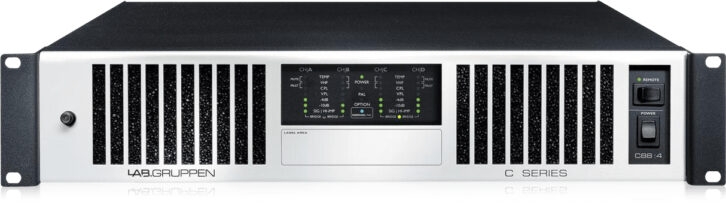 The Lab Gruppen C 88:4 is a powerful single frame, 4-channel installation amplifier with 2200W output from each channel at 2 ohms. On each channel there is an individually controlled voltage peak limiter. Each of these can be set for operation on low impedance or through a 70/100V speaker system. This works along with adjustable gain on the channel. This model can be operated as part of a NomadLink network system in which key amplifier parameters are displayed via DeviceControl software, and remote control of channel mutes and power on/off is managed efficiently under network control.
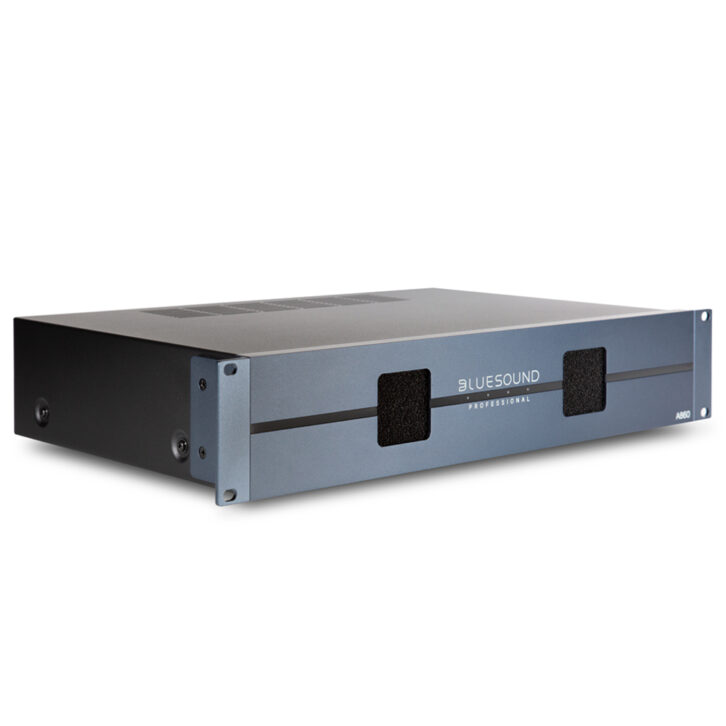 For bigger, multi-zone applications, the Bluesound Professional A860 amp is a 2RU rack mount design providing 8 channels as 50Wx8 at 8 ohms, 60Wx8 at 4 ohms or 120W at 8 ohms per pair of channels in bridged mode. When not in continuous use, the 0.5W low power standby mode can be activated remotely or automatically. Multiple units can be configured to operate as one and a global balanced input can be run to all outputs. Thermostatically controlled low noise fans make sure the unit keeps running cool and reliably. Separate amps will find each other on a Bluetooth network and the BluOS Controller app can be used for easy configuration into zoned outputs.
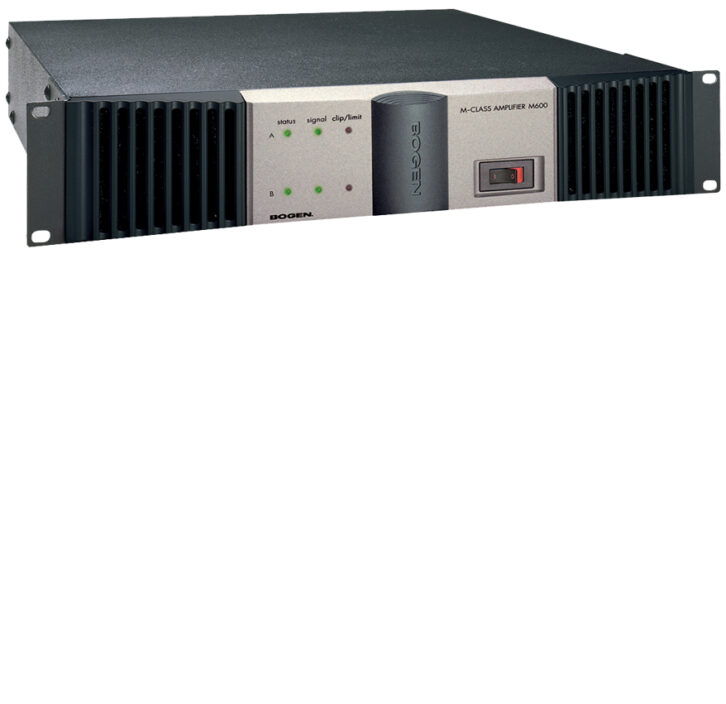 At the top of the line of M-Class modular power amps is the Bogen M600 with three modes of operation: Stereo, 70V Mono, or Dual Mono. Its modular input bays allow complete customization of signal input types to be a perfect fit for the facility in which the amp is installed. In 70V mono mode, the system delivers 1200W into a 4-ohm load and in stereo mode there is 600W per channel into 4 ohms. The 14-gauge steel chassis with cast aluminum front panel stands up to road use and rough wear.
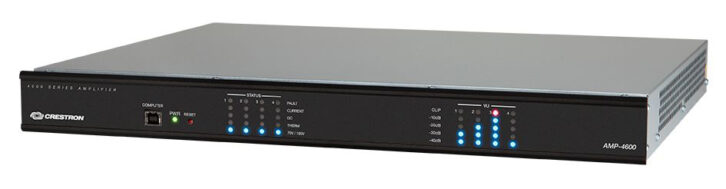 For installations that need four amp channels in a single rack space, the Crestron AMP-4600 provides it to complement the Crestron Avia family of digital signal processors. An advanced Class-D system, the AMP-4600 includes a universal power supply and delivers 600W per channel into 4 or 8 ohm low impedance loads. Adjacent pairs of channels may be configured for stereo or bridged operation. Users with the Avia Audio Tool software can have remote level control and monitoring. Centralized monitoring and control of multiple amplifiers throughout a facility is possible as part of a Crestron Fusion or Crestron XiO Cloud managed enterprise.
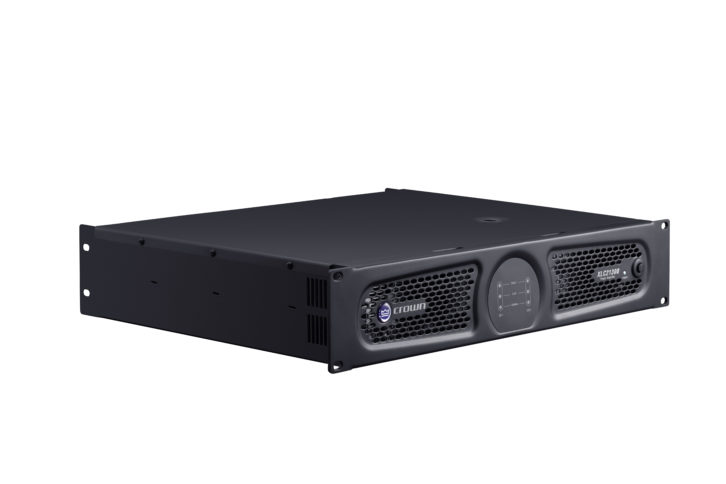 Rarely is there a more high-pressure, mission-critical environment than professional cinema and the two-channel, 1300W Crown Audio XLC 21300 is quite at home there. Capable of powering subwoofers at 8 or 4-ohm loads, the amp supports parallel, input Y and bridged-mono-output modes. Along with this unit, the addition of the JBL CPi2000 cinema processor (on the HD-15 input) and JBL Cinema Expansion Series speakers forms a complete cinema sound system. LED indicators include Signal, Clip, Power, Bridged Output and Fault. Stable performance is provided through forced-air cooling.
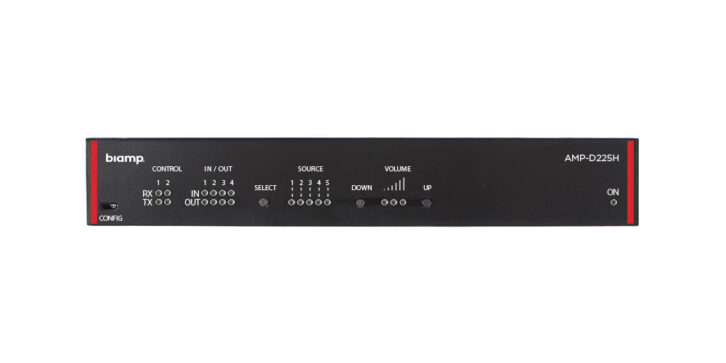 Another very space-saving sound solution is presented by the Biamp Systems AMP-D225H two-channel Class-D amplifier. Running without any cooling fans, the amplifier makes no noise so that it can be installed right where it is being used if need be. The 25W per channel device can be operated in bridge mode for more power to 4 or 8-ohm loads. There are four stereo inputs along with four GPIO and two RS-232 connections and its USB input enables direct audio connection and volume control from a computer.
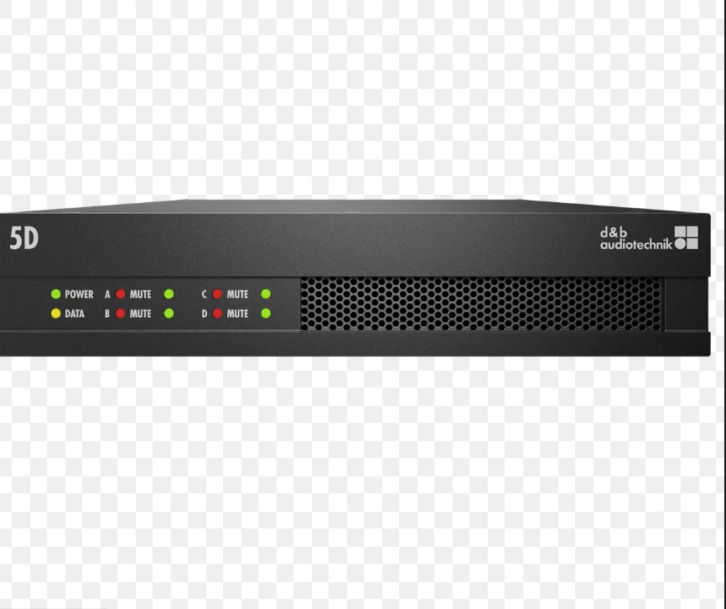 For permanent installation of the most reliable system available, the Dynacord C3600FDi from the Dynacord C Series is a popular favorite with its low impedance and 100V system capability. Integrated digital signal processing, power saving standby mode, front panel LC display, and intuitive system control software allow this unit to be custom configured to meet the needs of any venue, for any type of production. In a two-ohm load, the power from a single channel is 3200W while maximum power in bridge mode reaches 6000W.
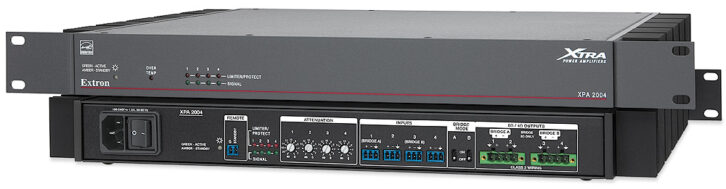 For less brute power needs but with more individual audio zones to cover, the Extron XPA 2004 four-channel amplifier uses its convection cooled, fanless operation to quietly make it happen with ENERGY STAR power efficiency. The patented Extron CDRS technology eliminates the high-frequency switching ripple characteristic of Class-D amplifiers. There is also power factor correction for steady power draw. Auto power-down, protection circuits, automatic clip limiter, bridgeable outputs, and a remote standby port are additional features.
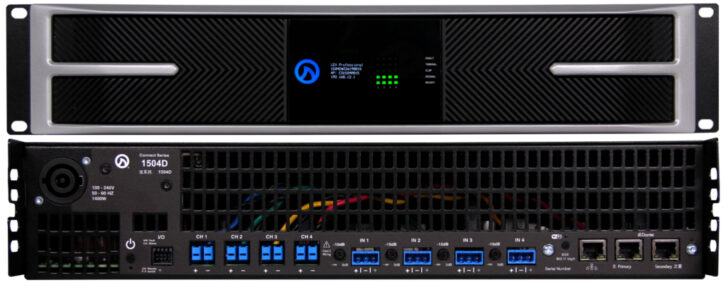 Another versatile and powerful amplifier for heavy duty service is the Lea Professional CS1504D, a member of the well-known CONNECTSERIES. Its connection capability includes both Dante and AES67. There are four balanced inputs with user selectable 26dB and 34dB input sensitivity, 20Hz to 20kHz frequency response, and a routable matrix in which any input can be run to any output with primary and secondary input priority. Features also include real-time load monitoring and pilot tone detection from internal or external sources. Temperature is maintained through front to rear variable fan speed cooling
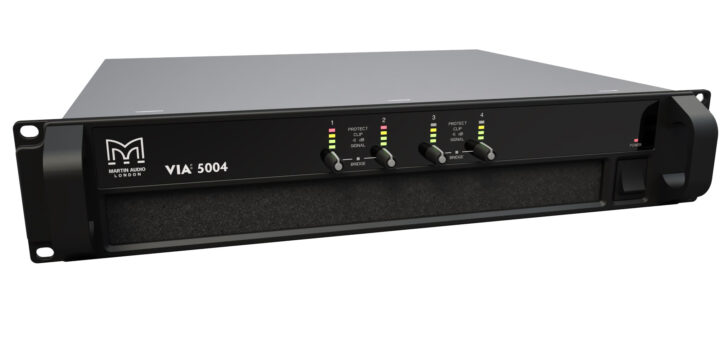 Five thousand watts divided over four channels are produced by the Martin Audio VIA5004, a 2RU Class-D unit with a switch mode power supply. Also configurable for 3-channel operation with TH Series 3-way systems, the VIA5004 has a variable speed cooling fan with front-to-back airflow, a power supply with 115V to 230V auto-sensing, comprehensive protection systems, and signal/clip limiter LEDs. The front panel features separate level controls for each channel along with an LED level indicator for each one. All VIA amplifiers are fitted with one SpeakON connector per amplifier channel.
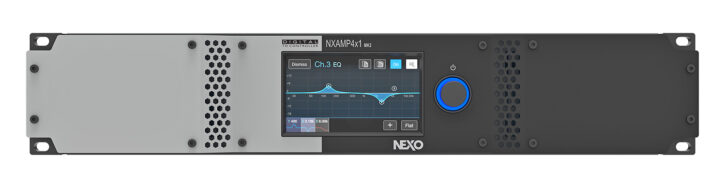 Impressive power from Yamaha and infinite control from Nexo are the main attractions for the Nexo NXAMP4X1MK2 4-channel Class-D amplifier. Well suited to fixed installation and touring, the system puts 1300W through each channel. 24-bit/96KHz converters and 64-bit signal processing provide top quality sound even at the highest power levels and the amp can run on anything from 100 to 240V for global power compatibility. This model offers four, high end analog inputs using cascaded converters. Digital inputs are also available through the rear panel expansion card slot offering optional AES/ EBU, EtherSound, Dante, Dante + AES/EBU or AES67 inputs, all with automatic analog fall-back.
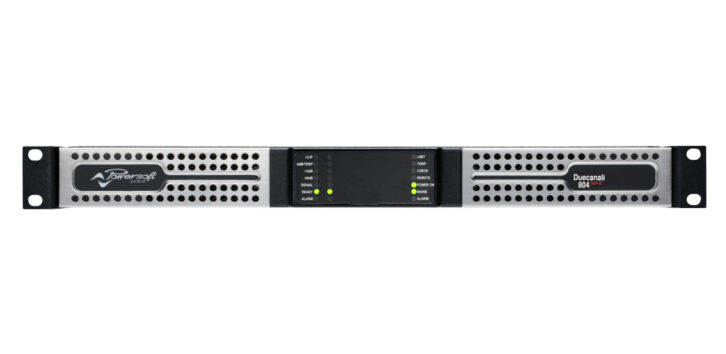 The Powersoft Duecanali 804 DSP+D is equally capable of working through low-Z and 70/100V systems using its fully integrated state-of-the-art DSP. The universal switch-mode power supply features Power Factor Correction and the output has a patented output filter with ripple cancellation network. The amplifier is fully safeguarded with a clip limiter, DC protection, short circuit protection, and thermal protection. This unit is lightweight and fits into a single rack space. There are NC/NO contacts per channel for alarm notifications, a remote ON/ OFF switch, and remote VCA control per channel. Output is 500W per channel into 2 ohms while bridge mode provides 1000W into 4 ohms.
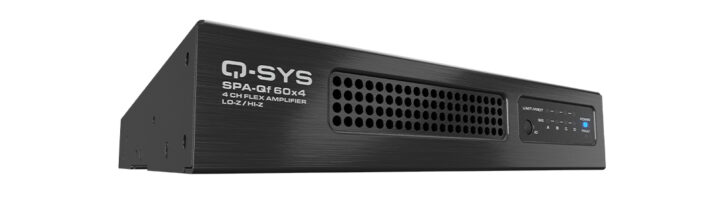
Users can have centralized Core OS processing, GPIO for control, two flex (line/mic) channels, and 60W each into four channels with the QSC Q-SYS SPA-Qf 60×4 amp system. Designed for operation on Q-SYS networks, the unit can provide 48V phantom power on inputs configured for microphones. This halfrack amplifier includes bi-directional GPIO and convection cooling for ultra-quiet operation. It can be connected to operate in low-Z or 70/100V speaker systems and output clear sound with 20Hz–20kHz (+0.2/-.08dB) frequency response. A rack/wall mounting kit is included.
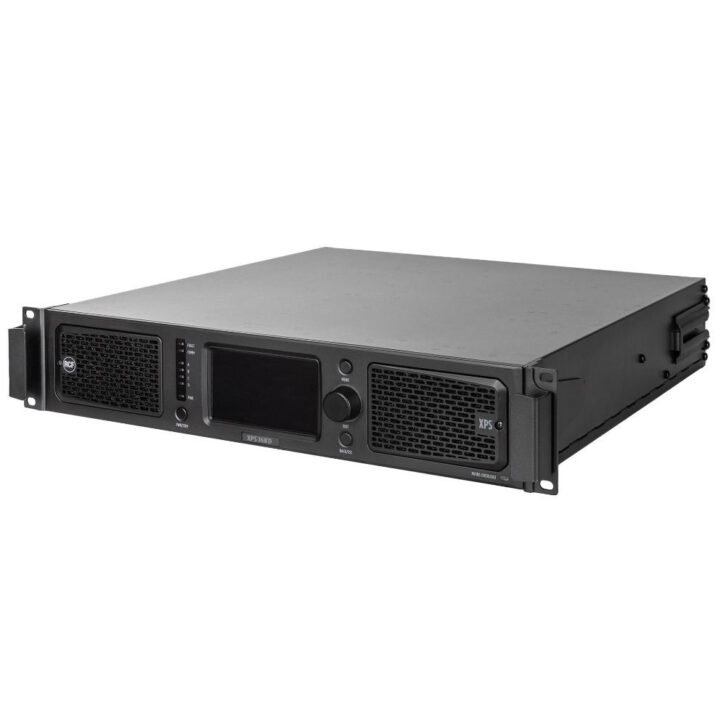 The RCF XPS 16KD Dante-equipped, four-channel amplifier uses RDNet Networked Management for advanced processing and routing. With 4000W into each of its four channels, the unit puts top quality sound through digital and analog I/O. Each output features: 4000ms output delay, EQ filters, crossovers, FIR filters, multiband compressor, RMS limiter, and thermal limiter. Controls and indicators are easy to see and operate through the large touch interface on the front panel. This includes manual muting, level control, and level indication. On the rear panel are connections for primary and secondary Dante networks, AES, analog XLRs, and two RJ45 terminals for network control.
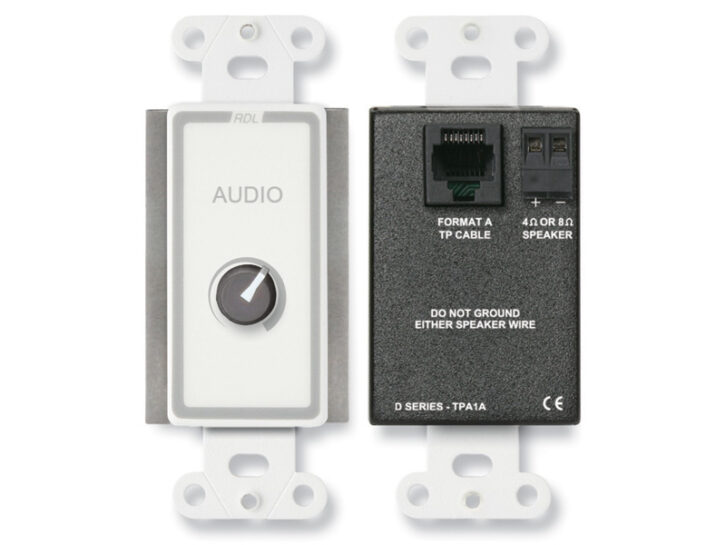 Amplification doesn’t always need to be high muscle. Sometimes just a touch of it at the fingertips is perfect and the RDL D-TPA1A has that situation covered. This Class-D amp fits into a single gang wall box and can be powered over twisted pair. The D-TPA1A units are twopair audio amplifier modules compatible with RDL Format A twisted pair products. Along with 24VDC power, the amp gets stereo audio over the RG45. The output drives either a 4 Ohm or 8 Ohm speaker with 6.5W into 4 ohms and 3.5W into an 8-ohm load. The single volume knob on the front panel is as simple and easy as it gets.
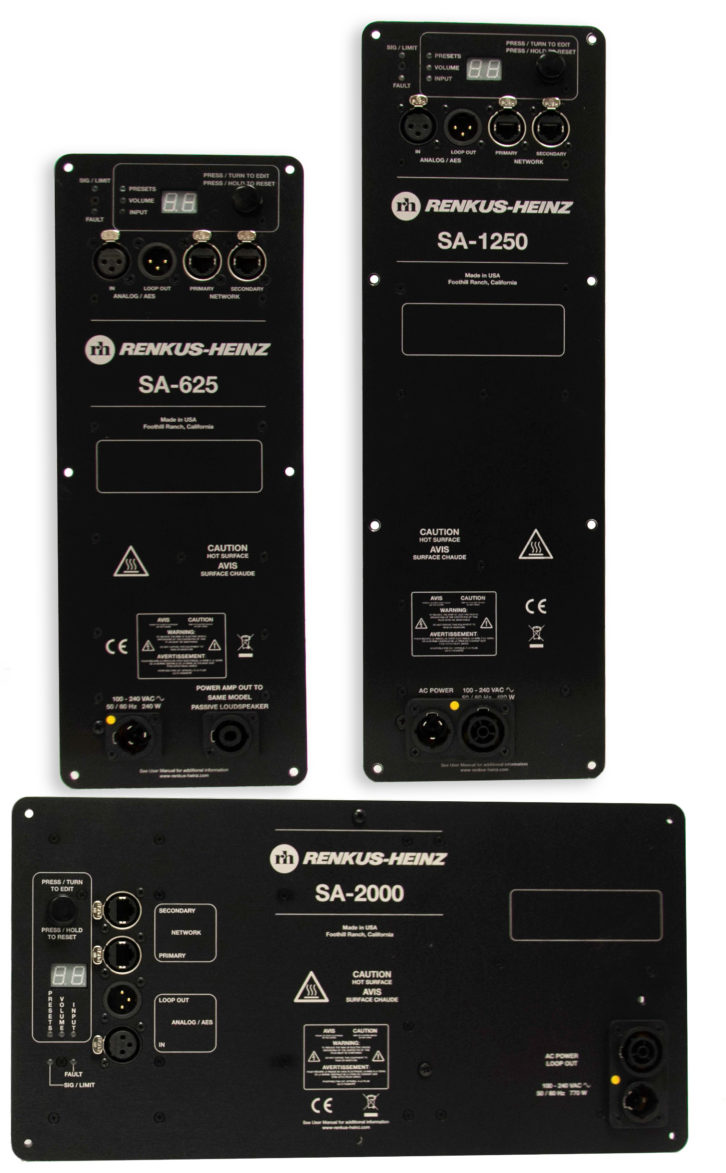 Designed to fit the company’s impressive line of powered speakers, the Renkus-Heinz SA Series amplifier modules enable a speaker network to input a variety of signals and be easily controlled and configured. The user has only to install speakers and select just the right SA Series amp module for the power and distribution needed. Each one is equipped with native DSP, including delay, equalization and nine available preset memories. These devices handle analog and AES. Optionally, a redundant Dante network can be used as well as fiber optic inputs. A standard feature is networked control through RHAON II System Manager software.
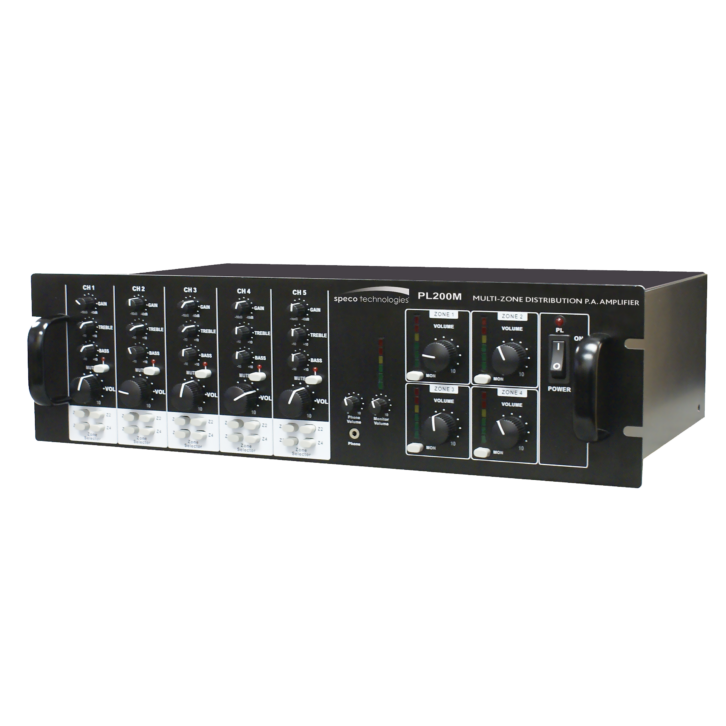 The Speco Technologies PL200M is the thing for multi-zone environments such as restaurants, museums or office locations. Up to five playback sources can be fed to as many as four zones with individual level, bass, and treble controls for low-Z or 70/100V distribution. A telephone interface and limited music on hold broaden its versatility. Mic 1 has selectable priority paging with internal toggle and there are three combination XLR/ 1/4in. inputs with selectable phantom power, line level or mic level. 40W power can be sent to each zone for a total of 160W RMS output power.
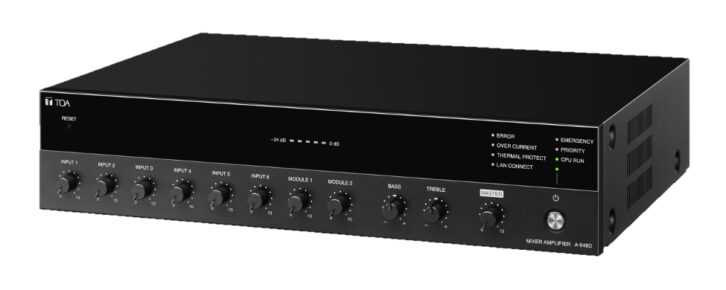 A digital mixer amplifier that can be configured with as many as eight inputs and with 480W of power, the TOA Electronics A-848D also features web-based control and monitoring. Onboard DSP and 900 series module slots make it a versatile performer. The remote troubleshooting capability makes it a favorite for integrators with church clients that have little or no permanent tech staff. Also available is an emergency override that replaces program sound with a highvolume announcement. Paging, noise masking, wireless mic receivers and other inputs can be configured through the choice of specific input modules.
 Leading the PX Series amps, the Yamaha PX10 two-channel, two rack space amplifier pumps 1000W into each channel at 8 ohms and 1200W into them at 4 ohms. It has alert lights, gain/limiter indications, signal presence LEDs and rotary level controls on the front panel in addition to a menu navigation button and USB input. All models have eight programmable and instantly recallable presets that can be saved to a thumb drive and shared with other PX amplifiers, substantially reducing setup time. A range of input types includes XLR and TRS inputs, along with binding post terminals. Outputs use SpeakON connectors and 1/4in. jacks.