Paris, France, September 16, 2026 — At Rue Boyer, the flagship Paris studio of Mix with the Masters, AEA ribbon microphones have become a familiar part of the recording setup. A pair of R84s lives in the drum booth, a pair of KU4s lives in the piano booth, and the studio turns to its R88 and R44s for strings and orchestral sessions. The collection has been put to work on projects including Charli XCX’s Music, Fashion, Film, Justice’s Hyperdrama, and recordings for the 2026 film Project Hail Mary.

Rue Boyer was built as both a commercial recording studio and a production and teaching hub for Mix with the Masters, an online music production education platform featuring in-depth sessions with leading producers and engineers. Much of that content is recorded directly at Rue Boyer. Its location in Paris brings artists, producers, and engineers from around the world through its doors. At any given time, one room may be occupied for weeks or months by an engineer, while another session can come together with little notice when an artist is passing through town.
Rue Boyer’s two main rooms are designed to accommodate that range of work. The larger Studio A is built around a 48-channel SSL E-Series console and includes dedicated drum, piano and vocal booths, while Studio B houses a vintage API 2448 and often serves as a production and mixing room. The facility’s booths and microphone panels can be routed to either room.
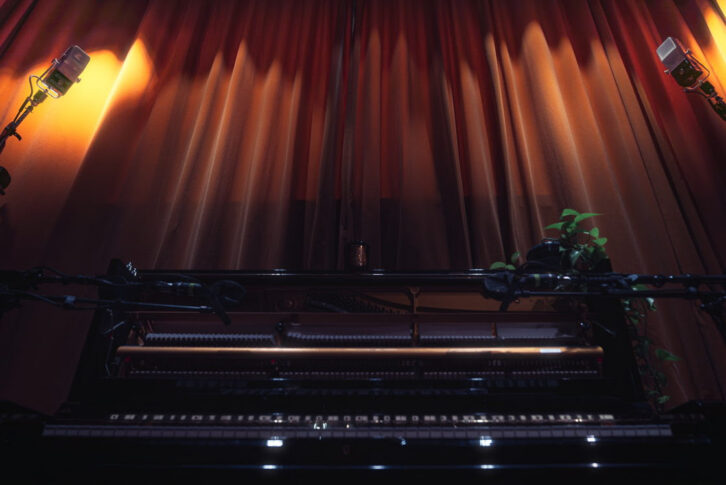
Within that setup, several of the studio’s AEA ribbons have settled into regular roles. “We have a pair of R84 microphones that we use constantly as room mics in the drum booth,” says Zach Anderson, General Assistant and Engineer at Rue Boyer. The pair has been used on sessions for Charli XCX’s Music, Fashion, Film and Justice’s Hyperdrama. In the piano booth, a pair of KU4s serves as room mics. “We use those constantly. They basically live there,” Anderson says. “They give a really nice warm tone, complement the top mics on the piano really well and give a real full sound to everything recorded there.”

Some of the music for the 2026 film Project Hail Mary was recorded at Rue Boyer, with French musician Thomas Bloch performing on instruments such as the cristal Baschet, ondes Martenot and glass harmonica. For those recordings, the studio relied heavily on its R88, using the stereo ribbon as the main microphone for almost all of the material captured there.
Anderson says he reaches for AEA ribbons when he wants the rich, darker tone of a ribbon microphone without worrying as much about noise. “We can be a little less worried about that and know that we’re going to get an amazing sound, and still maintain that ribbon quality,” he says.
The studio’s R44s also get used in less conventional ways. “Those are probably my favorites, just because we use them for fun things at the studio,” Anderson says. “We’ll put them in the lounge to re-amp sounds through there and create unique reverbs.”
To learn more about Rue Boyer and Mix with the Masters, visit https://mixwiththemasters.com/events/location/rue-boyer-studios
For more information about AEA Ribbon Mics, visit aearibbonmics.com
About AEA Ribbon Mics
Founded in 1964, AEA began as a record label and mobile recording studio before expanding into microphone repairs and full-scale manufacturing. In 1998, AEA introduced the R44C — an evolution of the iconic RCA 44BX — and has since developed a full range of microphones and preamps inspired by classic designs and built to modern standards. With a commitment to ultra-low noise circuitry, musical sound, and expert craftsmanship, AEA continues to push ribbon technology forward while honoring its legacy. All AEA products are proudly handcrafted in Pasadena, California.
Learn more at aearibbonmics.com