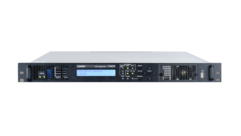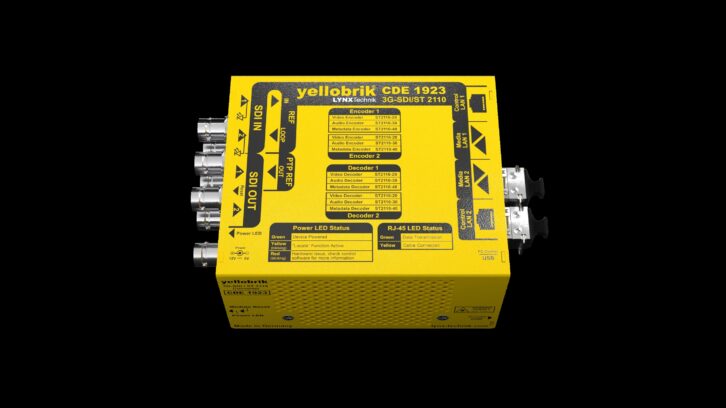
Ideal for broadcast facilities, outside broadcast trucks, production studios, and other applications transitioning from baseband SDI to IP, the CDE 1923 provides reliable signal conversion while addressing the synchronization requirements of both technologies.
Building on the yellobrik CDE 1922 and driven by customer feedback, the CDE 1923 retains its core bi-directional SDI-to-IP and IP-to-SDI conversion capabilities while adding dedicated Reference Input and Reference Output connections. These additional interfaces let the converter bridge the timing requirements of traditional SDI equipment and SMPTE ST 2110 IP networks in a single compact solution.
“We’re very proud to build upon the existing CDE 1922 platform and respond directly to what our customers have been asking for,” said Vincent Noyer, CTO at LYNX Technik. “By adding Reference Input and Reference Output while maintaining the same compact yellobrik form factor, we’ve been able to make an already versatile converter even more useful. The CDE 1923 gives customers greater flexibility when connecting SDI equipment to an ST 2110 environment, without adding complexity or requiring additional space.”
As broadcasters transition to IP, signal conversion is only part of the challenge. Traditional SDI systems typically rely on a physical reference signal for synchronization, while SMPTE ST 2110 networks use Precision Time Protocol (PTP), as defined by the SMPTE ST 2059 profile. The CDE 1923 provides a practical solution for bringing these two synchronization environments together.
Its Reference Input allows the SDI output to lock directly to a facility’s local reference, providing deterministic alignment with other SDI equipment. This enables the converter to integrate cleanly into an established baseband timing environment.
The Reference Output provides additional flexibility by enabling the converter to generate a Tri-Level Sync output from SMPTE ST 2059 PTP. It can also up-convert an input sync signal to Tri-Level Sync at a higher frame rate, providing a physical reference signal suitable for synchronizing connected SDI equipment.
By combining bi-directional 3G-SDI and SMPTE ST 2110 conversion with flexible reference connectivity, the yellobrik CDE 1923 helps facilities maintain synchronization across both SDI and IP domains. Developed in response to real-world customer requirements, CDE 1923 provides a straightforward and flexible solution for integrating base-band equipment into IP-based production environments.
About LYNX Technik:
LYNX Technik was founded in 2002 and is now an industry leader and technology provider of software and hardware interface solutions for real-time signal processing in audio-visual environments. LYNX Technik is an independent privately-owned company with its headquarters, research, and manufacturing facilities based in Weiterstadt, Germany. Sales and Support are covered through secondary distribution channels managed from its headquarters in Germany, USA (California), and Asia (Singapore). ISO 9001 and ISO 14001 accreditation demonstrate a commitment to quality and a determination to minimize environmental impact.
Product brands include greenMachine® multi-purpose processing platform, yellobrik® system as well as standalone plug-and-play modules, Series 5000™ rack and card-based series, LynxCentraal™ control system, and the Testor portable test signal generator and waveform analyzer.
Products include audio/video/fiber conversion, audio/video distribution, fiber splitters, CWDM mux/demux, audio embedding / de-embedding, audio delay, image processing, frame synchronizers, test generators, 4K transmission solutions, as well as a line of rack frames and accessories.
For more information about LYNX Technik’s products & services please visit: www.lynx-technik.com, www.lynx-usa.com. For sales, please email [email protected]. You can also find LYNX Technik on LinkedIn.