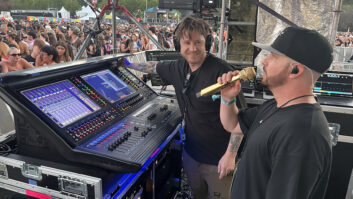
Photo above: Tate McRae FOH engineer Curtis McKenna (left) and monitor engineer Melvin Godfrey (right) at Lollapalooza 2026’s house mix position
Canadian singer, songwriter and dancer Tate McRae seemed to be everywhere in 2025, as her all-arena Miss Possessive Tour wound its way across three continents over the course of seven months. This year, McRae’s schedule has been a lot less busy, with just two festival shows at the beginning of August—Osheaga in Montreal and Lollapalooza in Chicago—for which her front-of-house and monitor engineers both adopted DiGiCo Quantum mixing consoles.
Curtis McKenna, McRae’s FOH engineer, mixed last year’s tour on his own console but, together with monitor engineer Melvin Godfrey, opted to use DiGiCo for her two North American summer festival dates. “One of the reasons that I switched was because you can find DiGiCo everywhere,” McKenna explains “And no matter which DiGiCo console it is, you can easily adapt your show file to that model. Normally I ask for a Quantum338, but I don’t mind a smaller version, and even if you go to the SD Range, it only takes 30 seconds on a flight to convert the show file.”
For Lollapalooza, AND Audio, owned by former touring monitor engineer Andy Hernandez, shipped both a Quantum326 and Quantum338 to Chicago. “We have a really good relationship with Andy,” McKenna says. “We’ve been using him for all our L.A. rehearsals.” The two DiGiCo consoles at Osheaga—a Quantum225 for McKenna and a Quantum338 for Godfrey—were supplied by Solotech, the Canadian festival’s production provider, ensuring plenty of onsite support for the McRae team if required. Not that McKenna, a seasoned DiGiCo operator, needed much support. This year, he reports, “I’ve only used DiGiCo consoles. I recently used a Q338 on a US and UK arena tour with an artist named Madison Beer, and it was nice to get back into the DiGiCo workflow.”
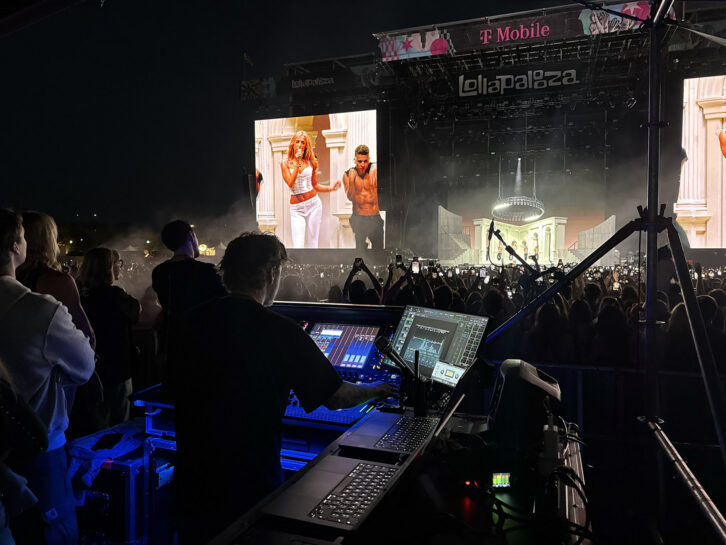
McKenna is a big fan of DiGiCo’s Macro capabilities and is looking forward to digging further into its newly enhanced features. “With the advanced function now, you can press one button, and it does a stream of multiple things, which is great. I’m probably going to get into it more next year, touring with Tate, which will be with DiGiCo. If you have some time to set up your Macros, they can be really powerful. It takes your brain away from the things that you don’t need to think about so you can just mix the show.”
Having cut his teeth in live sound in the analog era, McKenna likes to carry plenty of outboard processing on tour. “Again, that’s another powerful thing with the Macros where, if your outboard fails, it can bypass the insert and then engage something that replaces that within the board. During rehearsals, when I’ve got a lot of time, I’ll set a Macro so that, if my outboard compressor fails, it will then go to whatever flavor I can replace it with in Mustard. With all the extra stuff that DiGiCo has added recently to Mustard, you can achieve many different flavors of compression. I A/B test quite a lot, just to double-check that things are sitting right and make sure levels don’t drop or anything dramatically changes. Obviously, there will be some change to our ears, but from an audience perspective, it wouldn’t make a difference. I’d love to get into that more next year,” he says, “and perhaps even carry less outboard.”
McKenna, who started out as a musician, is a simple mixer, he says, and likes to watch the show and react to it. “I have everything accessible to me with the Quantum worksurface and I always lay out the console the same way, so I can rely on muscle memory and mix without looking at the console. I’m very basic, so my snapshots generally are for faders and mutes—that’s it. The fader movements get me in the right spot to start a song, and I don’t timecode my snapshots, because I like that flow. I like to do a lot of push and pull and create dynamics. I’m quite a creative engineer, and our musical director, Darion—or ‘DJ’, as we call him—is very open to me making my own decisions and adding my own flair. I like to do lots of delays, and if I feel like something needs extra reverb that isn’t in a track, I’ll add that myself. If I feel like the audience is in a good place, or I can feel that they are interacting with it a little bit more, I might push them a little bit.”
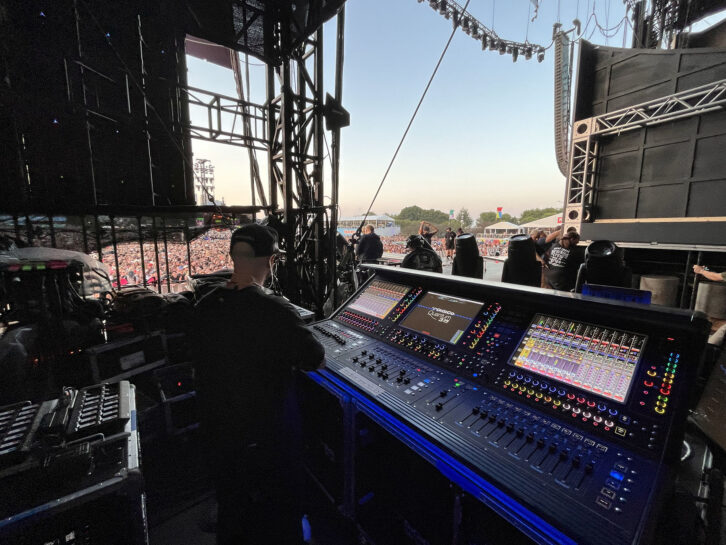
Like many FOH engineers, he mixes on the group faders. “My center section is my show section. And depending on how I work, sometimes, if I’m pushing stuff, it pushes other groups into compression. Everything still sits right, but you can achieve dynamics,” he says. He also has hidden layers, such as for his broadcast groups, which can be used to send the music, or just the reverbs, or other source elements, such as audience mics. “I use the Spice Rack and Mustard Processing to do some sidechain stuff, so the audience sits in the mix nicely. You can’t sit and listen to your broadcast mix while you’re mixing for Lollapalooza, so I set them up to look after themselves, internally. You’ve got enough tools onboard the console to really not need any outboard.”
McKenna also often carries an ultra-compact mixer on big tours and is considering purchasing a DiGiCo Quantum112 for McRae’s next excursion. “The beauty of the DiGiCo loop system is that you could use the smaller console as a sidecar, or have it as the broadcast console. Tate is getting to the point where most of her gigs will be broadcast, so with the Q112 as a dedicated broadcast desk, I could put my hands on faders fast, or alter something, or EQ something quickly, without taking away from my show. Sometimes, between full band shows, Tate does track shows, so with the right Pelican case to keep the weight down, the Q112 is perfect to roll in. So I think that’s something I‘ll be utilizing in the future.”
For more information on Tate McRae, visit www.tatemcrae.com.