Communication has always been the foundation of successful live production. Whether coordinating a live broadcast, sporting event, concert, theatrical production, corporate event, or film set, every department relies on instantaneous, reliable communication to make decisions in real time. Camera operators, stage managers, audio engineers, lighting programmers, producers, replay operators, and technical directors all depend on an intercom system that is as dependable as the infrastructure supporting the production itself.
For decades, matrix-based intercom systems have fulfilled this role. These systems, built around a centralized hardware frame, became the industry standard because they provided deterministic routing, high audio quality, and support for large numbers of users.
However, production workflows have evolved dramatically.
Today’s productions are no longer confined to a single control room or venue. Remote production, cloud-based workflows, distributed engineering teams, IP networking, virtual production environments, and hybrid events have fundamentally changed how crews communicate. As productions become more decentralized, the limitations of traditional framed intercom architectures become increasingly apparent.
This evolution has led to the development of frameless intercom systems—distributed communication platforms designed specifically for modern IP-based production environments.
Understanding Traditional Matrix Intercom Architecture
A traditional matrix intercom is built around a central processing frame. This hardware chassis contains the switching fabric, digital signal processing resources, routing engine, interface cards, power supplies, and timing required to manage every communication path throughout the system.
Every keypanel, wireless base station, four-wire interface, GPIO connection, and external device ultimately depends on this single matrix to establish and maintain audio routes.
This centralized design offers predictable performance and simplified signal management, but it also consolidates virtually every critical system function into one physical location.
While redundancy can be added through duplicated frames and backup power supplies, redundancy often comes at significant cost, increased rack space, additional configuration complexity, and operational overhead.
As systems grow larger, every expansion typically requires additional interface cards, increased processing capacity, new fiber or copper infrastructure, and careful capacity planning to ensure the matrix can support future growth.
The Engineering Challenges of Centralized Systems
Although matrix-based systems remain highly capable, their architecture introduces several engineering considerations that become more significant as productions become larger and more distributed.
Single Points of Failure: Perhaps the most obvious concern is architectural centralization.
Even in redundant systems, the primary processing frame represents a critical dependency. If a catastrophic hardware failure, power event, software issue, or network interruption isolates the matrix, communication across the production can be significantly impacted. Engineers often refer to this as a Single Point of Failure—a component whose failure can affect the operation of an entire system. While redundant matrix designs reduce this risk, they cannot completely eliminate the dependency on centralized processing.
Scalability Limitations: Traditional matrix systems also require capacity planning.
Each expansion consumes finite processing resources, interface ports, DSP capacity, and physical card slots. Growing productions often require purchasing additional interface cards or migrating to larger matrix frames before capacity is actually exhausted. This can lead to higher capital costs and reduced flexibility for organizations supporting productions of varying sizes.
Infrastructure Requirements: Because intelligence resides within the matrix, equipment must ultimately connect back to the central frame.
For productions spanning multiple venues, stadium campuses, convention centers, or remote production facilities, this often requires extensive fiber infrastructure, dedicated transport equipment, or leased communication circuits. As physical distances increase, infrastructure complexity grows accordingly.
Supporting Modern Workflows: Modern productions increasingly incorporate:
- Remote operators
- Distributed control rooms
- IP audio networks
- Cloud-based production resources
- Mobile production units
- Temporary event infrastructure
- Hybrid wired and wireless communications
Integrating these workflows into a traditional centralized architecture frequently requires additional gateways, protocol conversion, interface hardware, and network engineering. The communication system becomes another centralized appliance that must bridge multiple technologies instead of naturally operating within an IP network.
Distributed Architecture, A Different Approach: Frameless intercom systems approach these challenges differently.
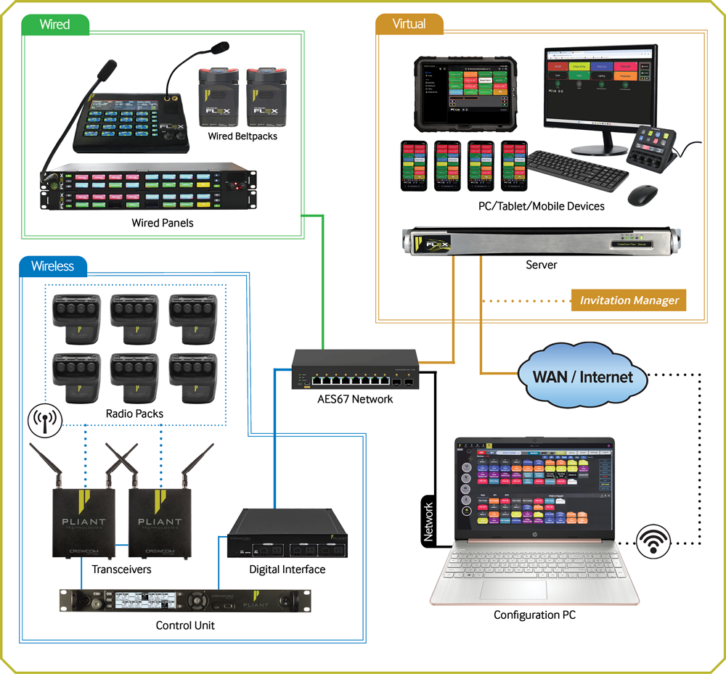
Instead of concentrating processing inside a single hardware chassis, intelligence is distributed throughout the network. Each device contributes processing capability while communicating over standard IP infrastructure. Rather than routing every conversation through one central matrix, communication paths are established across multiple distributed network nodes.
This architecture closely resembles the evolution seen in modern enterprise networking, storage systems, and cloud computing, where distributed services replace large centralized hardware appliances. The result is an intercom platform designed around resiliency rather than dependency.
Eliminating the Central Frame: Because there is no central matrix, there is no single hardware device responsible for maintaining every communication path.
If an individual network node experiences a fault, the remainder of the system continues operating independently. From an engineering perspective, this significantly improves overall system resilience by reducing architectural dependencies and minimizing the impact of localized hardware failures. Rather than protecting one large piece of equipment, reliability is achieved through distribution.
Scalability Without Fixed Limits: Distributed architectures also simplify system expansion.
Adding users or coverage areas generally involves deploying additional network-connected devices instead of expanding a centralized matrix. Since processing resources grow alongside the network itself, capacity scales more naturally with production requirements.
This approach is particularly valuable for rental companies, touring productions, broadcast facilities, universities, and corporate production departments whose communication needs frequently change. Instead of designing around the maximum possible production, systems can grow incrementally as operational requirements evolve.
Leveraging Standard IP Networks: Another significant advantage is the ability to utilize existing Ethernet infrastructure.
Rather than requiring dedicated matrix connectivity, distributed intercom devices communicate across standard managed IP networks using familiar networking practices such as VLAN segmentation, Quality of Service (QoS), redundant switching, and fiber backbone connectivity.
For broadcast and IT engineers, this allows intercom infrastructure to integrate more naturally into converged production networks alongside video-over-IP, audio-over-IP, control systems, and network management platforms. As organizations increasingly adopt standards-based IP infrastructure, communication systems can evolve alongside the broader network architecture instead of remaining isolated.
Supporting Hybrid Production Environments: Modern productions rarely operate entirely on-site.
Remote technical directors, cloud graphics operators, distributed replay teams, virtual production stages, and off-site engineering support have become increasingly common.
A distributed intercom architecture makes it easier to integrate local wireless users, wired stations, remote operators, and geographically separated facilities into a unified communications environment. Rather than forcing remote users through centralized hardware gateways, communication can extend across IP networks wherever appropriate bandwidth and network design exist.
Looking Ahead
The transition from framed to frameless intercom systems mirrors a larger trend occurring across the broadcast, AV, and live production industry.
Just as video routing, audio transport, storage, and production control have increasingly embraced distributed IP architectures, intercom technology is following the same path.
Centralized matrix systems remain capable and will continue serving applications for years to come. However, as productions demand greater flexibility, geographic distribution, and resilience, frameless architectures offer compelling engineering advantages.
Ultimately, the value of a frameless intercom system extends beyond eliminating a rack-mounted frame. It represents a shift toward communication infrastructure that is inherently scalable, fault-tolerant, and designed for the realities of modern production—where teams, devices, and workflows are no longer confined to a single location.